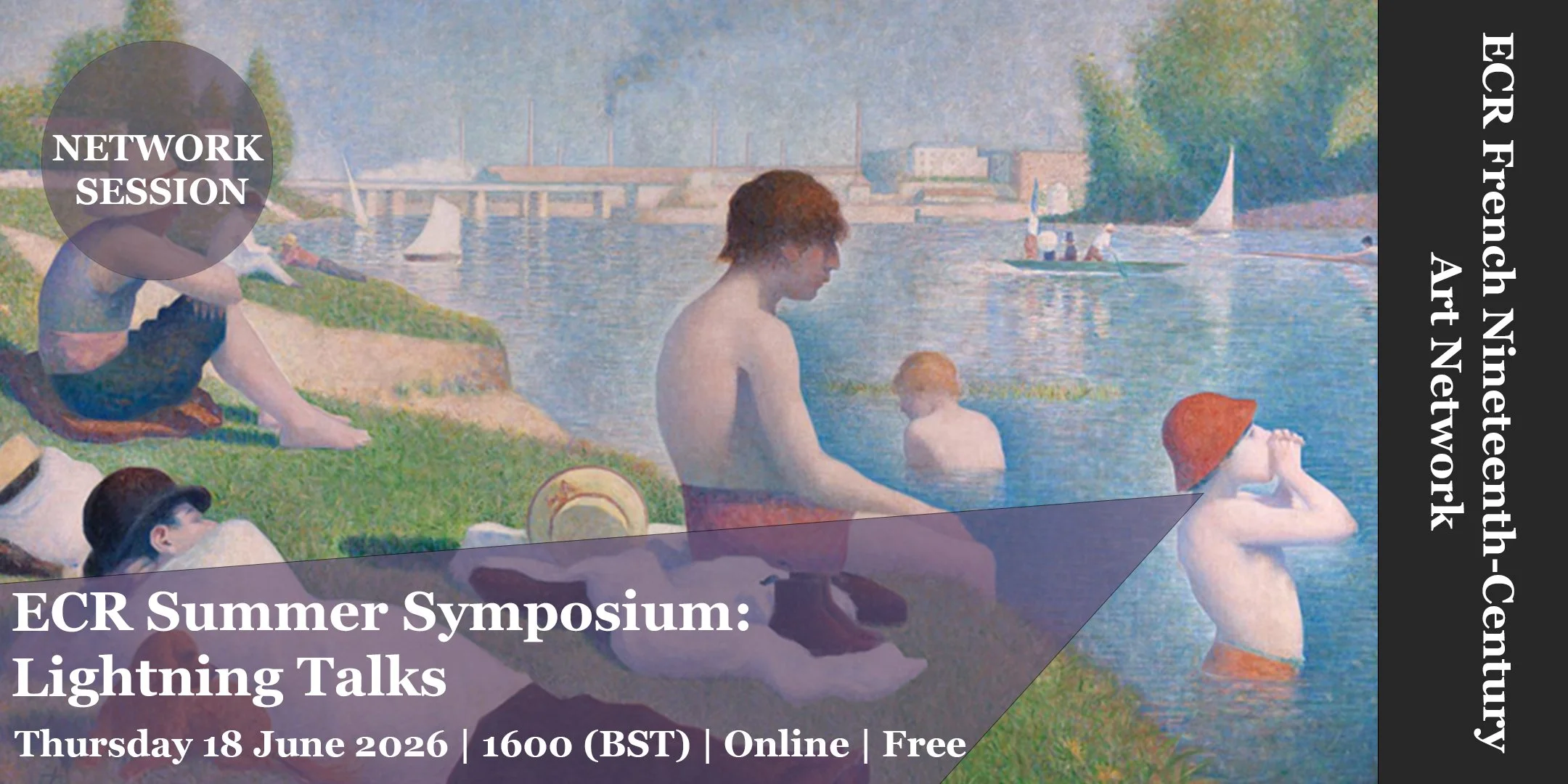
ECR French Nineteenth-Century Art Network presents:
ECR Summer Symposium: Lightning Talks
Thursday 18 June
1600 (BST) / 1700 (CEST) / 1100 (EDT) / 0800 (PDT)
As a wrap-up to the 2025–26 academic year, we are welcoming five speakers to give brief lightning talks (8–10 minutes) on an aspect of their current research related to Francophone visual and material culture within the long nineteenth century. These talks offer a platform for emerging scholars to workshop developing ideas and to engage with an informed, supportive audience, and we actively encourage presentations on projects that are still in progress. A brief, open discussion and Q&A will follow. Let’s spotlight their fantastic research and celebrate the start of summer!
Speaking will be:
“From Apollo to Hercules: Hypermasculine Bodies in the Envois de Rome, 1840s–1860s”
Viktoriia Bazyk is currently working on a dissertation that examines hypermasculine representations of masculinity in works produced by students of the Académie de France à Rome (the so-called envois de Rome) between the 1840s and the 1860s. In April, she undertook a research stay in Rome, conducting library research at the Bibliotheca Hertziana, consulting collections at the Villa Medici—the seat of the Académie, where the analyzed works were created—and studying major artworks across the city that may have informed these artists’ visual vocabularies and inspired their choice of subjects and archetypes. In her presentation, she will summarize her preliminary findings on how the plurality of styles and corporeal aesthetics available to viewers in the Eternal City may have prompted artists to depart from established academic ideals of the male nude.
Viktoriia Bazyk is a doctoral student at the University of Vienna, a research and teaching assistant at the Vienna Department of Art History and a fellow of the Vienna Doctoral School of Historical and Cultural Studies. In 2024, she was awarded the Sir-Ernst-Gombrich-Nachwuchspreis for her master’s thesis on transgressive masculinity in William Bouguereau’s painting Dante and Virgil in Hell. Currently, she is working on her PhD project entitled “Constructing hypermasculine masculinities: The envois de Rome and the academic male nude in mid-nineteenth-century France.” Her research interests include academic and salon painting in nineteenth-century France, gender and queer studies in art history, representations and constructions of masculinity in visual arts, and the nude as a means of artistic expression. Her most recent publication is “A Fresh Look at Muscular Masculinities” (Kunstchronik, April 2025).
“Painting Transcendence: Paul Baudry’s Ceiling for the Grand Foyer of the Palais Garnier”
Commissioned in 1861 during Baron Haussmann’s reconstruction of Paris, the Palais Garnier was conceived by Charles Garnier as a monument to imperial spectacle, artistic display, and social ritual. Central to this vision was the Grand Foyer, whose mirrored surfaces, gilded ornamentation, and monumental scale create an immersive environment intended to overwhelm and elevate the spectator. This talk examines Paul Baudry’s ceiling paintings in the Grand Foyer and argues that Baudry adapted the visual language of religious decoration to transform the Opéra into a modern site of transcendence. Through comparisons with the imagery of the Sistine Chapel and other Vatican interiors, the paper explores how Baudry adapted compositional arrangements and narrative modes associated with Vatican decoration to evoke the familiarity and authority of sacred space. By translating these conventions into a secular setting, Baudry reimagined the Palais Garnier as a temple of music and the arts, a space of spiritual elevation where spectacle itself became a transcendent experience.
Kelsey Yi Wing Yuen is a PhD candidate in the History of Art at the University of Cambridge. She holds a BA in History of Art and European Studies from the University of Hong Kong and an MLitt from the University of St Andrews. With academic and professional experience in both Hong Kong and the UK, her research focuses on nineteenth-century French art, architecture, and cultural history, with particular attention to the relationship between aesthetics, spectatorship, and social context. Supervised by Prof. Caroline van Eck, her doctoral project examines how the Paris Opéra Garnier stages spectacle through its architectural design, focusing on interpretive slippage in its reception from the Second Empire to the Third Republic.
“‘Pour s’instruire et pour s’amuser’: The Décennale of French Art at the 1889 Paris Exposition”
The state art exhibitions held as part of the Paris Expositions formed a key instrument of the Third Republic's cultural policy. Drawing on Ana Nasyrova’s dissertation project ‘In Pursuit of the Paris Salon: Official State Exhibitions in France, 1880–1900,’ this paper argues that, following the state’s withdrawal from the Paris Salon in 1880, it sought to establish a new national prestige exhibition in the form of the Décennale at the 1889 Exposition Universelle. However, despite the proclaimed ideals of a “Republic of the Arts,” the exhibition reinstated strategies of privileged exclusivity reminiscent of the Ancien Régime Salon system. By reaffirming genre hierarchies and favouring an older generation of academic painters, the state attempted to reassert its authority over artistic value and the general view of what should be considered high art.
Ana Nasyrova is an art historian and research associate at the Alte Nationalgalerie Berlin. She earned her master's degree in art and visual history at Humboldt-Universität zu Berlin (Humboldt University of Berlin), where she is currently pursuing her PhD with a dissertation titled “In Pursuit of the Paris Salon: Official Exhibitions in France, 1880–1900,” under the supervision of Prof. Dr. Claudia Blümle. Nasyrova specializes in nineteenth-century French and German art, with a particular interest in institutional history, political propaganda in the visual arts, and the changing definition and status of the visual arts under state influence.
“L’influence de la culture visuelle théâtrale de la fin du XIXe siècle sur l’illustration des pièces dans les éditions bibliophiliques”
Cette communication se propose d’explorer le constat suivant : le commerce de l’édition de luxe, qui connaît son âge d’or dans la première moitié du XXe siècle, publie une sélection récurrente de pièces de théâtre ayant rencontré un grand succès à la fin du XIXe siècle et intègre directement des éléments de ces mises en scène phares dans de riches programmes d’illustration. Ces citations visuelles témoignent de l’impact d’une industrie théâtrale toujours plus forte à la fin du siècle, qui s’exprime avant tout par l’image, qu’il s’agisse de la presse spécialisée ou des objets de memorabilia. Ce phénomène interroge ainsi la manière dont la culture visuelle théâtrale se prolonge au-delà de l’événement scénique et contribue à cristalliser un imaginaire, fixant durablement le mythe autour de certaines œuvres et de leurs interprètes. Une attention particulière sera portée à Pelléas et Mélisande, illustré par Carlos Schwabe, afin d’observer ces phénomènes de réinterprétation iconographique. Il s’agira de réfléchir aux processus de circulation transmédiatique et d’influence des images théâtrales sur l’illustration éditoriale.
Bérangère Juban est doctorante en première année d’histoire de l’art à l’université Paris 1 Panthéon-Sorbonne, au sein du laboratoire HICSA, sous la codirection de Catherine Méneux et de Mireille Losco-Lena. Ses recherches, qui prolongent un travail de master réalisé à l’université Lumière Lyon 2, portent sur la culture visuelle théâtrale de la fin du XIXe siècle et son influence sur l’illustration dans les éditions bibliophiliques. Elle s’intéresse aux circulations et aux transpositions de modèles visuels entre différents médias. Ses travaux s’inscrivent à la croisée des études sur la culture visuelle, de l’histoire du livre et des études théâtrales.
“Reimagining Versailles: Elsie de Wolfe and the Interiors of Villa Trianon”
Sara's doctoral dissertation examines the life and work of American-born, French-dwelling decorator Elsie de Wolfe, with a chapter focusing on her 1905 acquisition and redesign of Villa Trianon, an estate near the Château de Versailles. Framed within the long nineteenth century (1789–1914), this chapter traces de Wolfe’s fascination with French history and culture, particularly her obsession with Marie Antoinette and the spatial imaginaries of Versailles, including the Petit Trianon and the Temple of Love, and considers how these were visually and materially reinterpreted in her own home. The proposed talk draws on archival documents from the Archives communales de Versailles (letters, building plans, and related ephemera) and object-based research at the Cooper Hewitt Smithsonian Design Museum (furniture and textile samples) to elucidate the relationship between these historical sites and de Wolfe’s interiors. As a work in progress, it explores how stylistic revivals operate across this extended temporal frame.
Sara Shields-Rivard (she/her) is a PhD candidate in Art History at Queen’s University (Canada). Her dissertation examines the gendered and racial implications of Elsie de Wolfe’s life and design work, situating her practice through the transnational contexts of the places she lived and travelled—Canada, the United States, France, and India—and through her connections to other creative women, including Elsa Schiaparelli and Princess Sita Devi of Kapurthala. Her research on this topic can be found in Dwelling at the Margins of Empire: Global Perspectives of Home (2025) and in the forthcoming "Special Issue: Domestic" of the Interiors journal.