ECR French Nineteenth-Century Art Network Research Forum:
Doubly Other: Black Harem Eunuchs in Gérôme’s Orient
Dr. Brigid M. Boyle, independent scholar
Thursday 22 January 2026
1700 (GMT) // 1800 (CET) // 1200 (EST) // 0900 (PST)
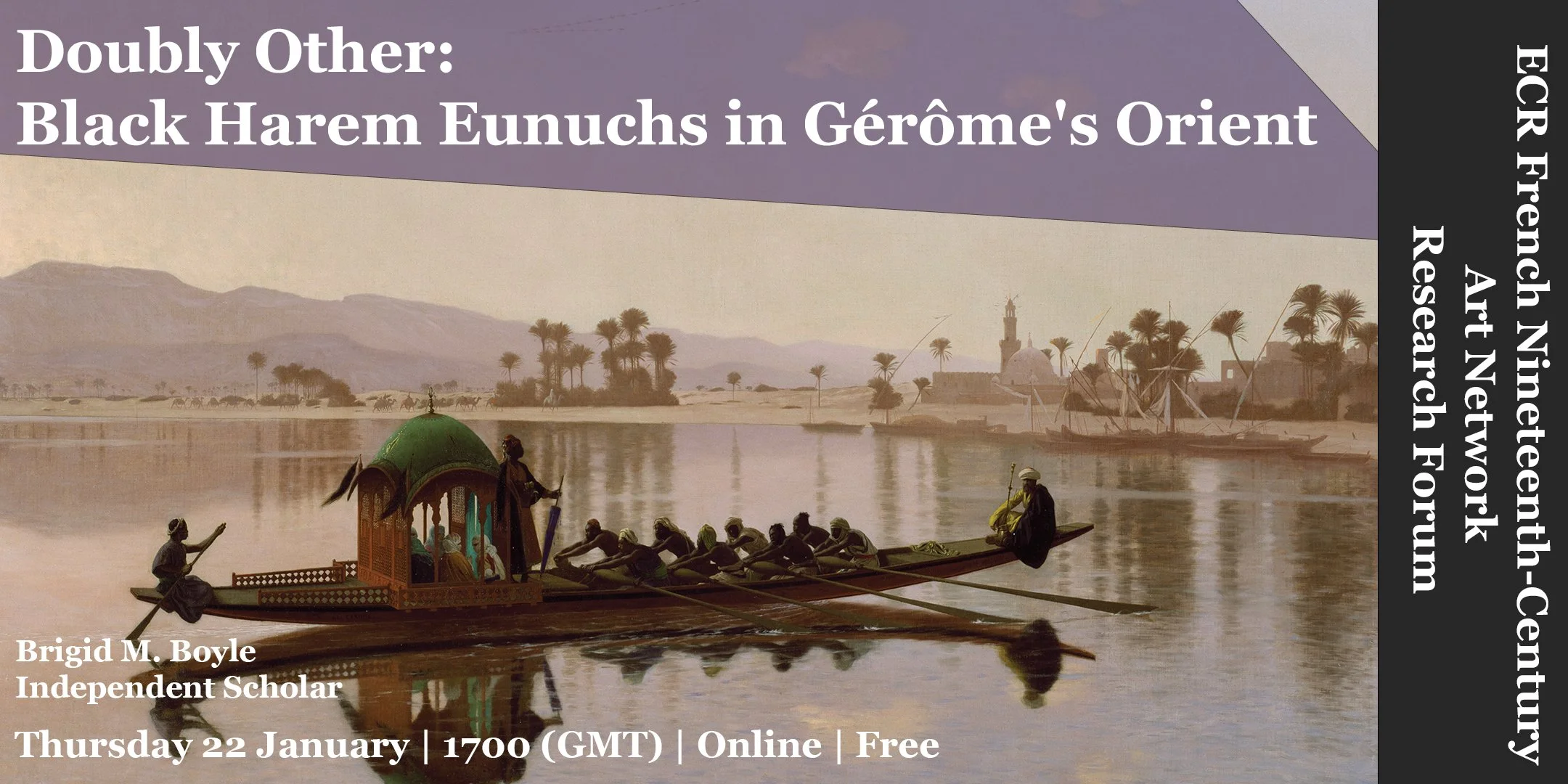
Enslaved Black eunuchs were ubiquitous in the Ottoman Empire from the early sixteenth to late nineteenth centuries. They performed a wide range of jobs but were most famous for overseeing female harems thanks to literary works like Montesquieu’s Persian Letters (1721). Orientalist artists often portrayed them as privileged insiders mingling with odalisques in exotic interiors or as hypermasculine armed guards standing sentry at harem thresholds. Jean-Léon Gérôme (1824–1904), however, mostly eschewed these visual conventions. Between 1859 and 1894, he produced three plein-air harem scenes that depict Black eunuchs out in the world, publicly chaperoning the sultan’s wives and concubines. This talk will consider these works as a group to reveal Gérôme’s efforts to demystify and de-eroticize Black harem eunuchs.
Brigid M. Boyle received her PhD in Art History from Rutgers University in 2024. She specializes in French art of the long nineteenth century, with particular expertise in Orientalism. Her dissertation examined Jean-Léon Gérôme’s representations of Black soldiers, performers, animal workers, and eunuchs in relation to period discourse on race and gender. She previously served as Bloch Family Foundation Doctoral Fellow at the Nelson-Atkins Museum of Art, where she co-launched the digital collection catalogue French Paintings and Pastels, 1600–1945. Her writing has appeared in Male Bonds in Nineteenth-Century Art (2021) and Winterthur Portfolio, and she is currently co-editing the first critical edition of Gérôme’s correspondence.