Call for Papers: Impressionism Now: New Directions in the Field
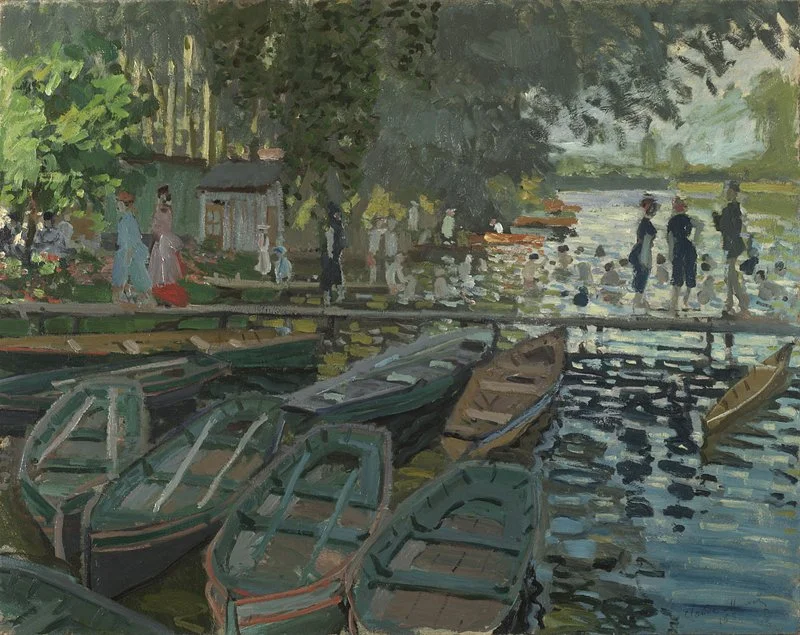
Bathers at La Grenouillère, Claude Monet, 1869 © The National Gallery, London. Bequeathed by Mrs M.S. Walzer as part of the Richard and Sophie Walzer Bequest, 1979.
Impressionism Now: New Directions in the Field
Pigott Theatre, The National Gallery, London, Friday 22 January 2027
Held in conjunction with the exhibition Renoir & Love (3 October 2026 - 31 January 2027) and organised in collaboration with Impressionist Futures and the ECR French Nineteenth-Century Art Network..
Organisers: Dr Chiara Di Stefano, Associate Curator of Post-1800 Paintings, The National Gallery; Dr Allison Deutsch, Departmental Lecturer in History of Art, University of Oxford Lifelong Learning; Matthew French, University of Birmingham; Dr Samuel Raybone, Lecturer in History of Art, University of Glasgow.
Call for Papers
Organised in conjunction with the exhibition Renoir and Love (3 October 2026 – 31 January 2027), this international conference advances recent research on Impressionism. Bringing together museum professionals, academics, conservators and emerging scholars, Impressionism Now: New Directions in the Field aims to highlight new avenues of enquiry and ask where the most vital directions in the study of Impressionism lie today.
Impressionism remains among the most widely exhibited and studied movements in the history of art, but the field has undergone profound change. Transnational and decolonial scholarship have challenged longstanding Francocentric narratives, while new methodological approaches have expanded the questions asked of Impressionist artists, objects, and practices. Together, these developments invite a reassessment of the movement's histories, geographies, and meanings. This symposium seeks to explore how the field might continue to be renewed, and which established narratives might now be reconsidered. Particular attention will be given to recent research emerging from museums and collections. Over the past two decades, museums have played a central role in shaping new interpretations of Impressionism, not only through collection-based research, technical analysis and conservation campaigns, but also through new exhibition narratives. We therefore particularly welcome contributions that reflect upon the ways in which curatorial, conservation and collections-based research can challenge or expand established art-historical accounts.
The symposium aims to reflect the full diversity of voices and perspectives currently working on Impressionism. Postgraduate and early-career researchers, independent scholars, museum professionals and conservators are therefore warmly encouraged to submit proposals. Papers will be delivered in English. A limited number of bursaries are available to support accepted speakers who do not have access to institutional funding.
Topics could include, but are not limited to:
Bodies, Identity and Power: new feminist and queer approaches to Impressionism; models, professional and otherwise; the politics of looking, representation and artistic labour.
Global and transnational Impressionisms: the circulation, migration and translation of Impressionism beyond France; centre and periphery; networks of artists, dealers, collectors and exhibitions; Impressionism from perspectives both inside and outside Europe; coloniality and the Impressionist gaze.
Ecocritical approaches: planetary, oceanic, and ecocritical approaches to Impressionism; landscape, climate, industrialisation, extractivism, and the transformation of the natural environment; animal and plant perspectives.
Materials, techniques and conservation: technical analysis, conservation and material approaches to Impressionist objects.
Echoes and Afterlives: reception and reverberation in twentieth- and twenty-first-century art and culture; Impressionisms before the late nineteenth century; “Old Master” Impressionists; periodisation and historiography
Pedagogy and public engagement: new approaches to teaching and interpreting Impressionism; expanding audiences for research; communicating new scholarship within and beyond universities and museums.
Lived time: Impressionism off the clock and beyond the instant; queer time, crip time, racialised time; childhood, aging, and chrononormativity; temporalities of care; geological time, more-than-human time, and the temporalities of slow violence.
Interdisciplinary and collaborative research: Impressionism beyond art history; collaborations between art historians, curators, scientists, humanists, philosophers, and beyond; Impressionism in contemporary art practice.
Networks and relationships: the social networks of Impressionism; artworks as social agents; collaborative creation and multi-authorship within Impressionism.
Multi-media: Impressionism beyond oil painting; Impressionist furniture, prints, drawings, pastels, photographs, and beyond; tactile Impressionisms; Impressionists’ objects, collections, and ephemera.
Impressionism and dis/ability: Impressionist artists’ experiences of dis/ability; ableist and medicalised receptions of Impressionism; dis/ability and the display of Impressionism today.
Impressionism’s archives: ownership and commodification of Impressionisms’ historical archives; addressing structural violence, erasure, and archival silences; counter-archival methods for expanding Impressionisms’ histories; Impressionism and critical digital humanities.
These themes are intended only as prompts, and proposals opening other new lines of enquiry are warmly welcomed.
Please send an abstract of no more than 300 words, together with a short biography of no more than 150 words, to research.events@nationalgallery.org.uk by 5 October 2026.
Proposals should be for 15-minute papers and should include your name, institutional affiliation (if applicable), preferred email contact and any accessibility requirements.
The organisers aim to notify contributors of the outcome within two weeks of the closing date.