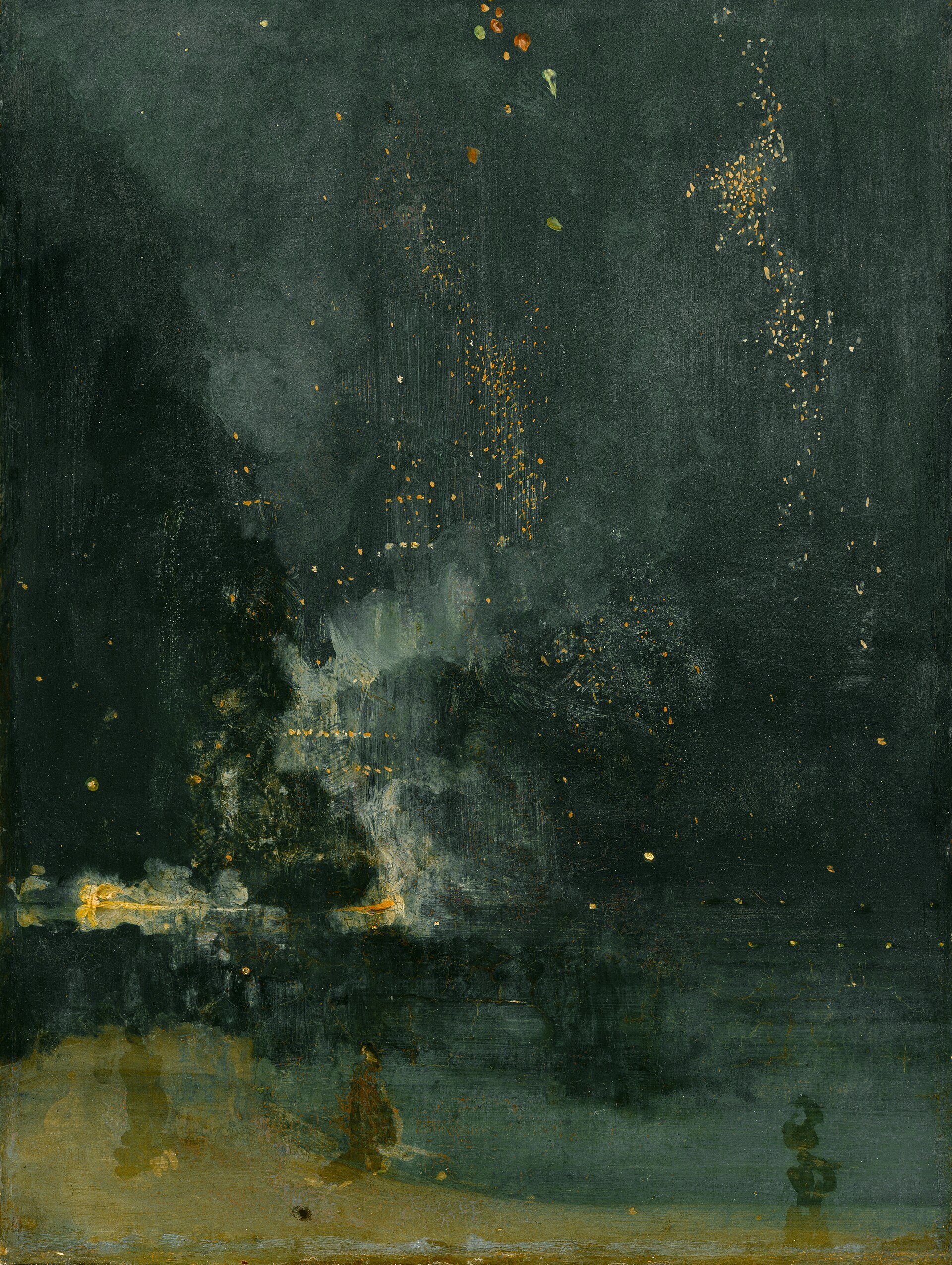
Research Forum: Le whistlérisme : par-delà la thèse, de l’exposition au livre
ECR French Nineteenth-Century Art Network Research Forum:
“Le whistlérisme : par-delà la thèse, de l’exposition au livre”
Dr. Laura Valette
Thursday 29 October 2026
1830 (CET) // 1730 (GMT) // 1330 (ET) // 1030 (PT)
L’impact de l’œuvre de James McNeill Whistler sur l’art européen et états-unien de la fin du XIXe siècle et du début du XXe siècle fut immense, pérenne et protéiforme. Paradoxalement, Whistler a longtemps été appréhendé à travers le prisme de l’artiste solitaire, mais le travail de recherche sur les sources de première main indique qu’il bénéficiait d’un réseau de sociabilité très important et d’un nombre impressionnant d’épigones. C’est ce postulat qui a été développé à l’occasion de la thèse de doctorat Le whistlérisme, 1878-1914 soutenue en 2020. Contrairement à un écueil répandu, la soutenance d’une thèse de doctorat n’est pas un point final mais bien le point de départ d’une reformulation : comment le savoir produit dans le cadre académique peut-il migrer vers d’autres formats de diffusion tels qu’une exposition ou un ouvrage scientifique ? Cette communication se propose d’examiner ce processus à travers une étude comparée et ainsi établir une mise en regard, du point de départ qu’est la thèse en elle-même qui a servi de terreau au projet d’exposition James Abbott McNeill Whistler : l’effet papillon présenté au musée des Beaux-Arts de Rouen en 2024, jusqu’à la publication du manuscrit de thèse remanié, Dans le sillage de Whistler, permettant d’observer in vivo les mécanismes de transposition à l’œuvre.
Laura Valette est docteure en histoire de l’art. Après avoir soutenu sa thèse Le whistlérisme, 1878-1914 en 2020 à l’Université Paris 1 Panthéon-Sorbonne (Prix de l’Art Période, 2023), elle a été lauréate de la bourse postdoctorale de la Terra Foundation for American Art à l’INHA afin de poursuivre ses recherches sur l’atelier de Whistler à l’Académie Carmen à Paris. En 2024, elle a été co-commissaire de l’exposition James Abbott McNeill Whistler : l’effet papillon présentée au Musée des Beaux-Arts de Rouen dans le cadre du Festival Normandie Impressionniste. Elle a co-dirigé l’ouvrage collectif James McNeill Whistler’s Reception and Artistic Legacy : Inventing Whistlerism publié chez Routledge en 2026, et son manuscrit de thèse remanié, intitulé Dans le sillage de Whistler, paraîtra aux SUP en novembre prochain.
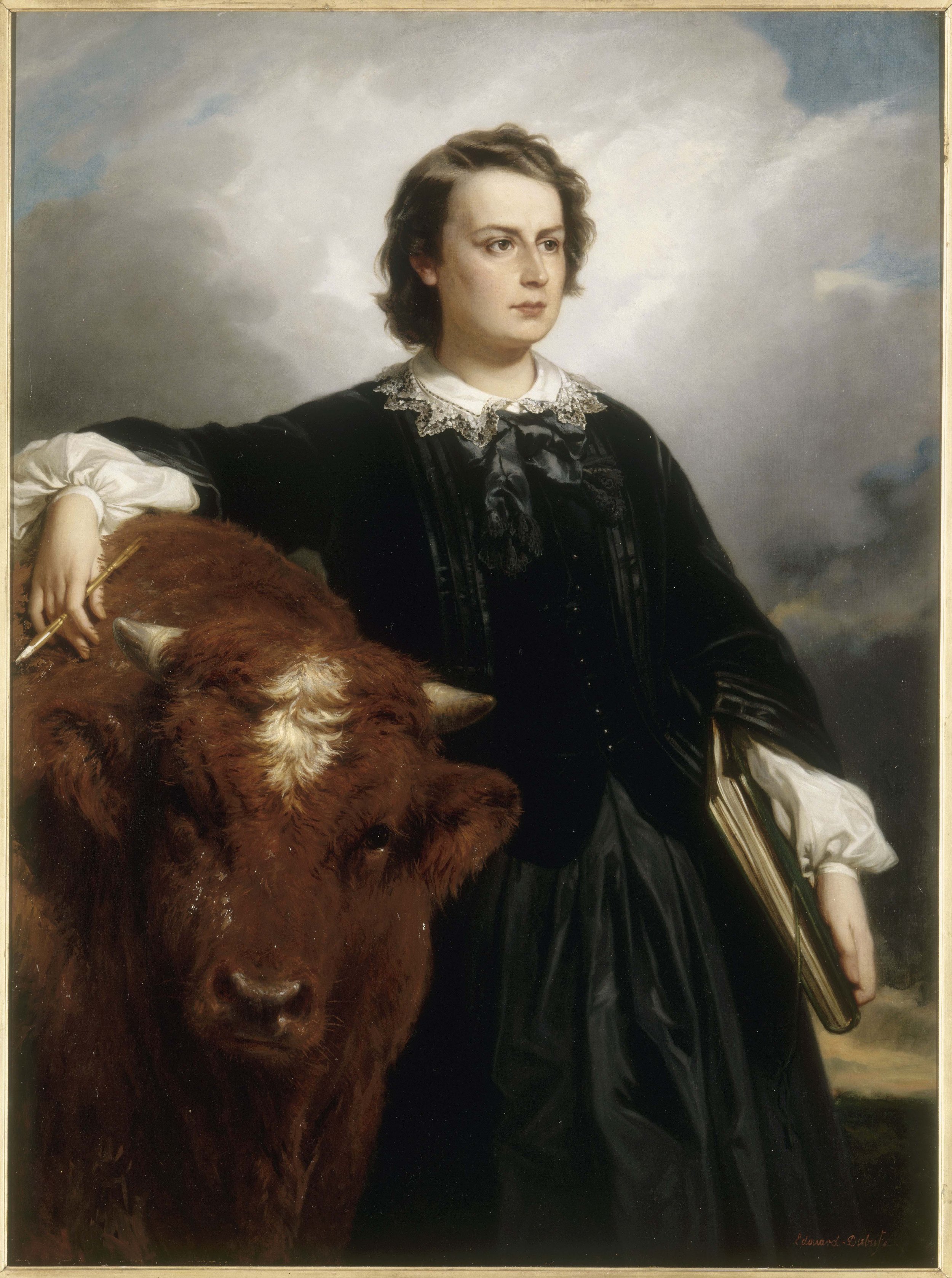
Gender, Queerness, and Dissident Aesthetics in Nineteenth-Century France
ECR French Nineteenth-Century Art Network Event:
“Gender, Queerness, and Dissident Aesthetics in Nineteenth-Century France”
Thursday 19 November 2026
1800 (CET) // 1700 (GMT) // 1200 (EST) // 0900 (PST)
The nineteenth-century French visual field was shaped by persistent negotiations around gender, sexuality, social belonging, and artistic convention. This session brings together three papers that approach these questions from distinct perspectives, examining how artists, artworks, and artistic communities could challenge, negotiate, or expose the limits of normative categories. From the Saint-Simonian communities of Ménilmontant and By-Thomery to the public construction of Rosa Bonheur’s unconventional celebrity and the homosocial worlds represented in Renoir’s paintings, the presentations explore the ways in which gendered and sexual identities were articulated through aesthetic forms, social relations, and practices of looking. Together, they ask how queer and dissident aesthetics might offer new ways of understanding nineteenth-century French art, its institutions, and its competing models of belonging.
Mal Meisels - “Taking the Habit: Religious Performance and Orientalist Drag in early Saint-Simonian Costuming Practices (1832–1833)”
This talk will analyze the costuming practices of Saint-Simonian disciples in Paris, Lyon, Marseille, Constantinople, Alexandria, Cairo, Beirut, and Jerusalem in 1832 and 1833. Saint-Simonianism, a religious and social movement founded in the early nineteenth century by noble-born French philosopher Henri de Saint-Simon, advocated for principles of universal association, industrial progress, and androgynous theology. In the early 1830s, Prosper Enfantin, a key religious leader after Saint-Simon’s death, encouraged his followers to transform their doctrine into fleshy realities with costumes, architecture, religious performances, and communal living. Meisels argues that Enfantin’s Saint-Simonian doctrine was buttressed by queer aesthetics, and these principles were predicated upon an orientalist imaginary. The resulting artistic production from this queer and orientalist aesthetics became critical for the movement’s proselytizing efforts in France and abroad. Meisels will highlight how Saint-Simonians adopted clothing items and motifs from across time, space, and cultures—a form of drag—to reflect their utopian, yet colonial, pursuits for international audiences.
Mal Meisels (they/them) is a Ph.D. candidate in the UCLA Department of Art History. They specialize in nineteenth-century French art with a focus on queer aesthetics, citizenship, human-nonhuman relations, and Orientalism. They recently published the article, "Queer Aesthetics and Its Others: Human Autonomy and Nonhuman Subjugation in the Passy Cravat (1864)," in Arts about Rosa Bonheur and her collaborators. Mal's dissertation, “Making Spirit Matter: Queer Aesthetics and the Figuration of Doctrine in Experiments with Saint-Simonian Citizenship (1830–1870),” follows Saint-Simonian artists, artisans, performers, and audiences who employed a queer aesthetics to pursue various forms of citizenship (familial, universal, imperial, and industrial) from 1830–1870. Mal’s research is deeply connected to their teaching and curatorial practices. In 2025, they curated Queer Kin: Histories of Subversive Love at the William Andrews Clark Memorial Library, closely attending to moments of LGBTQIA+ mutual care, romantic connection, sexual desire, and family structures within the Clark’s collections.
Dr. Jennifer Thatcher - “Interviewing Rosa Bonheur”
How did it feel to be internationally famous in the second half of the nineteenth century: a source of pride or an unwelcome intrusion? The most successful woman artist in France during her lifetime, Rosa Bonheur was interviewed around a dozen times in French and American periodicals from 1858, when she was 36, to 1899, the year of her death at 77. In this paper, research-in-progress for a monograph on the Transatlantic origins of the artist interview, Dr. Thatcher will investigate the backstory to some of these interviews, including the reputation of interviewer and publication, and the fact that so many interviewers turned up uninvited. Were interviewers interested in Bonheur’s work as a world-renowned animalière; her rags-to-riches background as a self-taught artist from a humble family of artists; or her unconventional lifestyle in her isolated chateau, living with another woman among a menagerie of domestic and exotic animals?
Dr. Jennifer Thatcher is an art historian, critic and public programmes curator. She is the co-editor of Theorising the Artist Interview (Routledge, 2025) and is working on a monograph titled The Golden Age of the Artist Interview for British Academy Publishing. She is currently a British Academy-funded postdoctoral fellow at Manchester Metropolitan University, researching the nineteenth-century history of the artist interview. She was co-curator of the 2023 Folkestone Book Festival; public programmes curator for the Folkestone Triennial (2014, 2017) and the Whitstable Biennale (2016). She publishes regularly as an art critic.
Anna E. Dobbins - “The Company of Men: Queer Potential in Renoir’s Luncheon of the Boating Party”
In her 1986 essay “Renoir’s Men: Constructing the Myth of the Natural,” Linda Nochlin asserts that “Renoir represents men not merely as consumers of pleasure, but as instruments of it as well.” Nochlin’s reading of Renoir’s paintings situates this pleasure solely within the realm of heterosexual desire. My paper seeks to push this assertion further by investigating the homosocial bonds between male figures in the oeuvre of Pierre-Auguste Renoir to assert an alternative reading of desire within his work. In doing so, I argue for a consideration of queer desire within Renoir’s Luncheon of the Boating Party (1881). Using the theoretical insights of Eve Kosofsky Sedgwick’s Between Men: English Literature and Male Homosocial Desire I contend that the perceived heterosexual rivalry between male subjects in Renoir’s paintings (as they compete for the attention of women) might be a palatable disguise for homosexual desire.
Anna E. Dobbins is an advanced doctoral candidate studying modern and contemporary art at the University of Florida. Her research investigates the construction of gender, sexuality, and eroticism in the nineteenth and twentieth centuries. Anna has presented her research at CAA, the Nineteenth-Century Studies Association, Workshopping Future Directions of Impressionism, and the Feminist inter/Modernist Association. Her research has been supported by the Yale LGBT Studies Research Fellowship and the Rothman Doctoral Fellowship in the Humanities. She is currently completing her dissertation project titled: “Women Surrealists and Queer World Building: Ecology, Abjection, and Dissolution.”
Research Forum: Developing New Feminist Methods: Sexism, Misogyny, and Modern Art

ECR French Nineteenth-Century Art Network Research Forum:
Developing New Feminist Methods: Sexism, Misogyny, and Modern Art
Dr. Allison Leigh, University of Louisiana at Lafayette
Thursday 10 December 2026
1800 (CET) // 1700 (GMT) // 1200 (EST) // 0900 (PST)
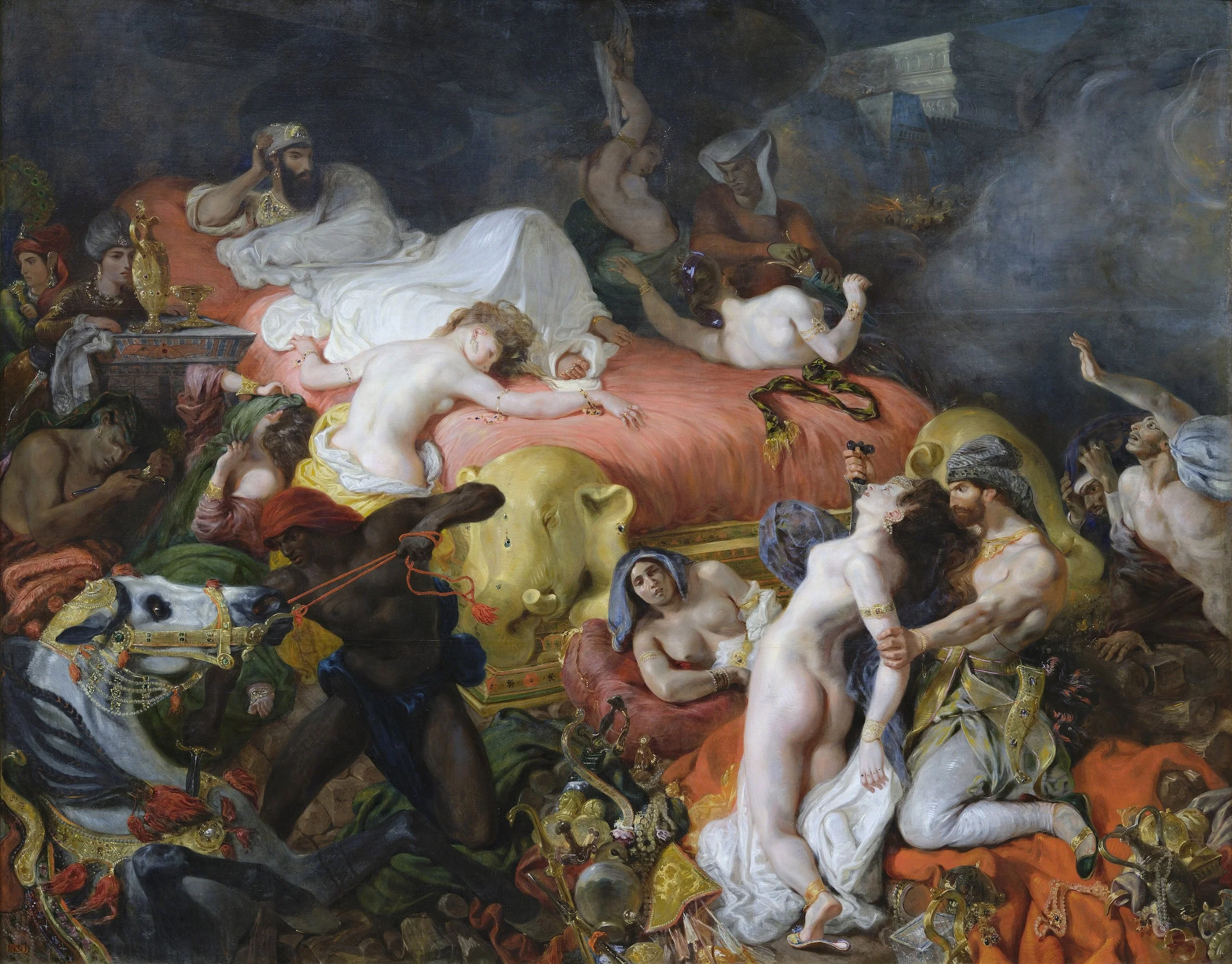
In the last hundred years, art history canonized several nineteenth- and early twentieth-century painters who made artworks with a similar essential content. From paintings showing women being gruesomely murdered by Eugène Delacroix to the erotically charged depictions that Paul Gauguin made of his teenage Polynesian brides—much of what is now considered the best modern art focused on either violent or degrading depictions of women. This Research Forum will reveal the research and writing processes behind a novel investigation of how diverse forms of contempt directed at women came to saturate the art world. Professor Allison Leigh will share how her forthcoming book, The Misogynists: A Reckoning With Modern Art, emerged from her experiences teaching undergraduates. She will also discuss her application of a renewed feminist lens, one that sees the pervasiveness of misogyny as inherent to the art historical canon.
Allison Leigh is the SLEMCO and Board of Regents Support Fund Endowed Professor in Art at the University of Louisiana at Lafayette. She is a specialist in European and Russian art of the long nineteenth century and the author of Picturing Russia’s Men: Masculinity and Modernity in 19th-Century Painting (Bloomsbury, 2020) as well as the co-editor of Russian Orientalism in a Global Context: Hybridity, Encounter, and Representation (Manchester University Press, 2023). A recipient of numerous grants and fellowships, her forthcoming book titled The Misogynists: A Reckoning With Modern Art will be published by Abrams in November.
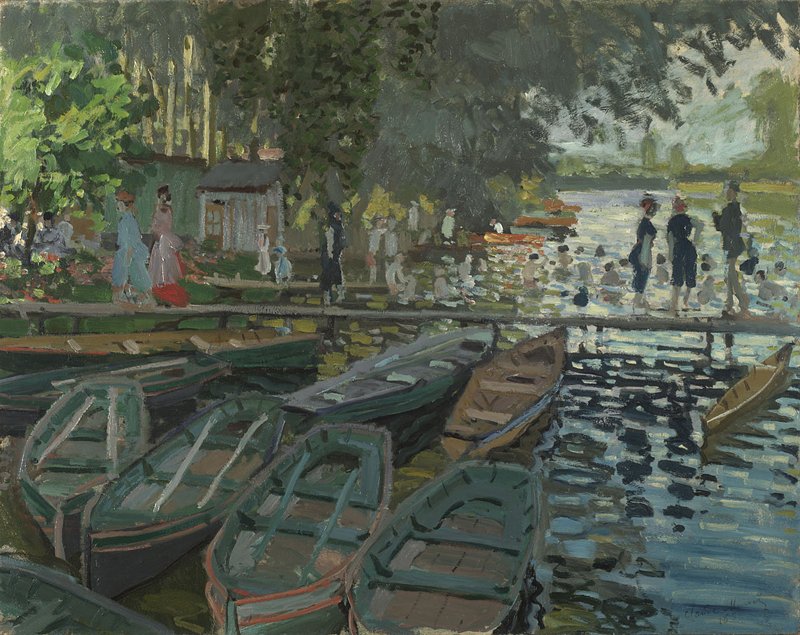
Impressionism Now: New Directions in the Field
CALL FOR PAPERS:
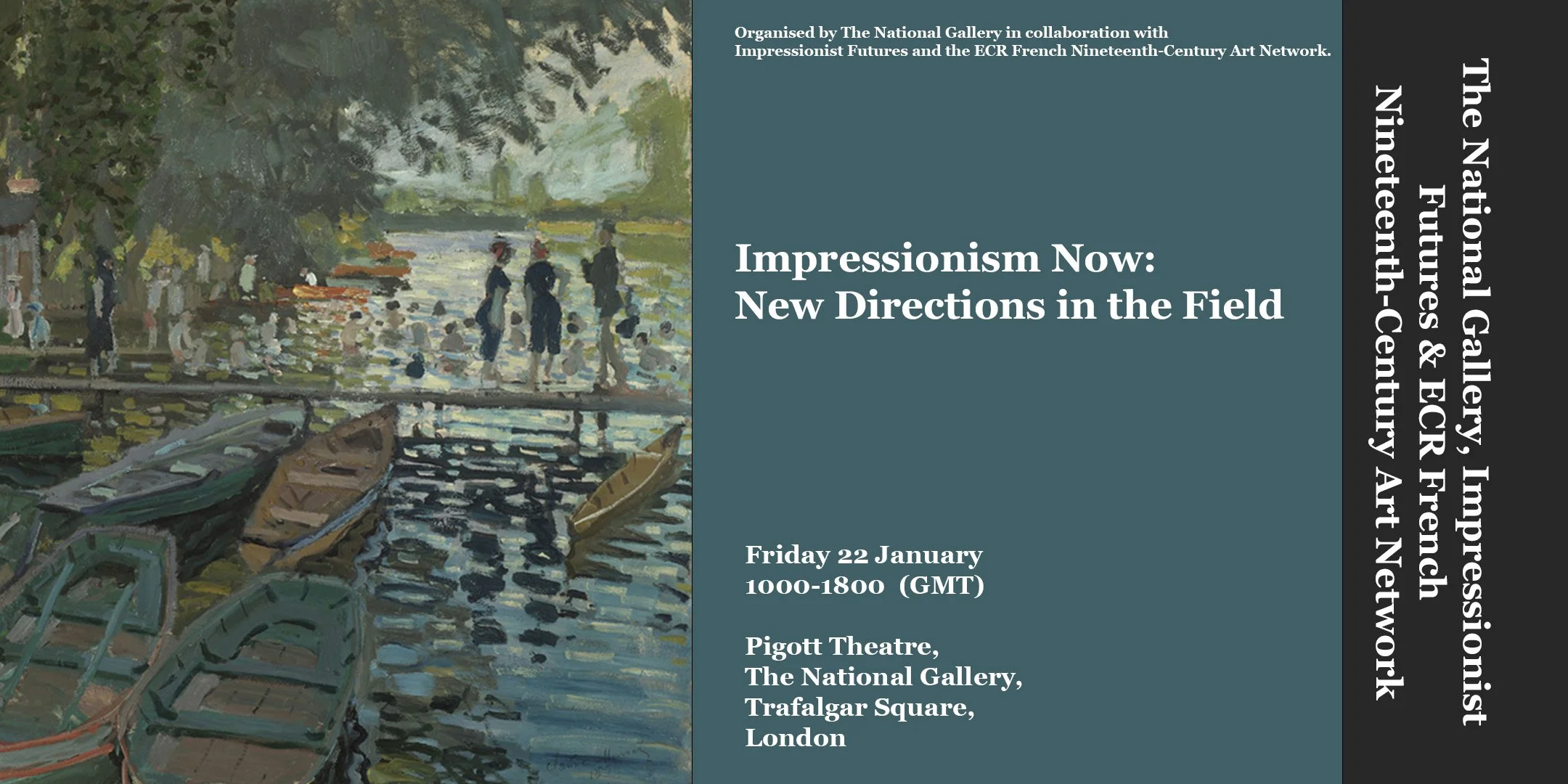
Impressionism Now: New Directions in the Field
Pigott Theatre, The National Gallery, London, Friday 22 January 2027
Held in conjunction with the exhibition Renoir & Love (3 October 2026 - 31 January 2027) and organised in collaboration with Impressionist Futures and the ECR French Nineteenth-Century Art Network.
Organisers: Dr Chiara Di Stefano, Associate Curator of Post-1800 Paintings, The National Gallery; Dr Allison Deutsch, Departmental Lecturer in History of Art, University of Oxford Lifelong Learning; Matthew French, University of Birmingham; Dr Samuel Raybone, Lecturer in History of Art, University of Glasgow.
Call for Papers
Organised in conjunction with the exhibition Renoir and Love (3 October 2026 – 31 January 2027), this international conference advances recent research on Impressionism. Bringing together museum professionals, academics, conservators and emerging scholars, Impressionism Now: New Directions in the Field aims to highlight new avenues of enquiry and ask where the most vital directions in the study of Impressionism lie today.
Impressionism remains among the most widely exhibited and studied movements in the history of art, but the field has undergone profound change. Transnational and decolonial scholarship have challenged longstanding Francocentric narratives, while new methodological approaches have expanded the questions asked of Impressionist artists, objects, and practices. Together, these developments invite a reassessment of the movement's histories, geographies, and meanings. This symposium seeks to explore how the field might continue to be renewed, and which established narratives might now be reconsidered. Particular attention will be given to recent research emerging from museums and collections. Over the past two decades, museums have played a central role in shaping new interpretations of Impressionism, not only through collection-based research, technical analysis and conservation campaigns, but also through new exhibition narratives. We therefore particularly welcome contributions that reflect upon the ways in which curatorial, conservation and collections-based research can challenge or expand established art-historical accounts.
The symposium aims to reflect the full diversity of voices and perspectives currently working on Impressionism. Postgraduate and early-career researchers, independent scholars, museum professionals and conservators are therefore warmly encouraged to submit proposals. Papers will be delivered in English. A limited number of bursaries are available to support accepted speakers who do not have access to institutional funding.
Topics could include, but are not limited to:
Bodies, Identity and Power: new feminist and queer approaches to Impressionism; models, professional and otherwise; the politics of looking, representation and artistic labour.
Global and transnational Impressionisms: the circulation, migration and translation of Impressionism beyond France; centre and periphery; networks of artists, dealers, collectors and exhibitions; Impressionism from perspectives both inside and outside Europe; coloniality and the Impressionist gaze.
Ecocritical approaches: planetary, oceanic, and ecocritical approaches to Impressionism; landscape, climate, industrialisation, extractivism, and the transformation of the natural environment; animal and plant perspectives.
Materials, techniques and conservation: technical analysis, conservation and material approaches to Impressionist objects.
Echoes and Afterlives: reception and reverberation in twentieth- and twenty-first-century art and culture; Impressionisms before the late nineteenth century; “Old Master” Impressionists; periodisation and historiography
Pedagogy and public engagement: new approaches to teaching and interpreting Impressionism; expanding audiences for research; communicating new scholarship within and beyond universities and museums.
Lived time: Impressionism off the clock and beyond the instant; queer time, crip time, racialised time; childhood, aging, and chrononormativity; temporalities of care; geological time, more-than-human time, and the temporalities of slow violence.
Interdisciplinary and collaborative research: Impressionism beyond art history; collaborations between art historians, curators, scientists, humanists, philosophers, and beyond; Impressionism in contemporary art practice.
Networks and relationships: the social networks of Impressionism; artworks as social agents; collaborative creation and multi-authorship within Impressionism.
Multi-media: Impressionism beyond oil painting; Impressionist furniture, prints, drawings, pastels, photographs, and beyond; tactile Impressionisms; Impressionists’ objects, collections, and ephemera.
Impressionism and dis/ability: Impressionist artists’ experiences of dis/ability; ableist and medicalised receptions of Impressionism; dis/ability and the display of Impressionism today.
Impressionism’s archives: ownership and commodification of Impressionisms’ historical archives; addressing structural violence, erasure, and archival silences; counter-archival methods for expanding Impressionisms’ histories; Impressionism and critical digital humanities.
These themes are intended only as prompts, and proposals opening other new lines of enquiry are warmly welcomed.
Please send an abstract of no more than 300 words, together with a short biography of no more than 150 words, to research.events@nationalgallery.org.uk by 5 October 2026.
Proposals should be for 15-minute papers and should include your name, institutional affiliation (if applicable), preferred email contact and any accessibility requirements.
The organisers aim to notify contributors of the outcome within two weeks of the closing date.
Curatorial Roundtable: 19th-Century French Painting in American College and University Museum Collections
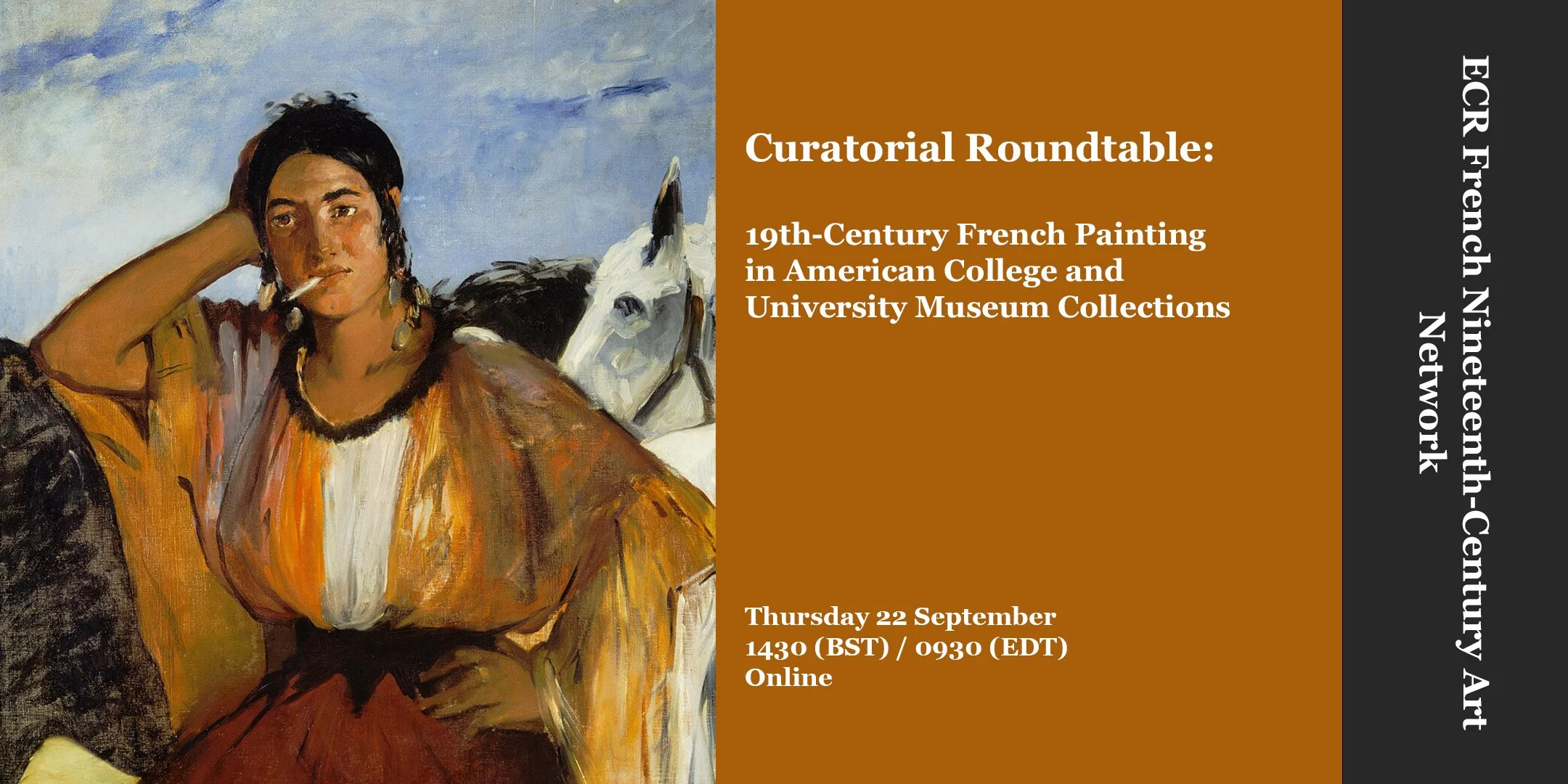
ECR French Nineteenth-Century Art Network presents:
Curatorial Roundtable: 19th-Century French Painting in American College and University Museum Collections
Tuesday 22 September
1530 (CEST) // 1430 (BST) // 0930 (EDT) // 0630 (PDT)
Nineteenth-century French paintings can be found in almost every American college and university museum. How do they fit in permanent collection gallery installations, changing exhibition programs, object-based curricula, and larger campus community life? This panel welcomes three speakers—all affiliated with academic institutions—to discuss at the professorial, curatorial, and directorial level how the longer nineteenth-century plays a role in teaching, collecting, and producing new scholarship within the context of higher education.
Participants:
Sean Kramer
Sean Kramer is Teaching Assistant Professor in Museum Studies and Art History at the University of Pittsburgh, where he teaches courses on the history and ethics of collecting, approaches to collections management, and exhibition development. Before joining the faculty at Pitt, Sean was the Andrew W. Mellon Postdoctoral Curatorial Fellow at the Bowdoin College Museum of Art. In this role, he oversaw curricular engagement with the museum and organized exhibition projects that ranged from nineteenth-century to contemporary art, including subjects such as personhood and dignity and the transatlantic popularity of Harriet Beecher Stowe’s 1852 novel Uncle Tom’s Cabin. He completed his PhD at the University of Michigan in 2022; he holds a BA and an MA from The University of Kansas.
Dr. Kramer will offer a preview of the upcoming reinstallation project Look Again, which opens in November 2026 and will be the first reimagining in almost seventeen years of the Thomas H. and Polly W. Bredt Gallery of European and American Art at the University of Michigan Museum of Art (UMMA). Look Again aims to provide viewers glimpses into significant moments in the museum’s collecting history while asking how art from late nineteenth-century Europe and the United States might still resonate with us. As UMMA, along with numerous other museums, moves away from the encyclopedic model, what does it mean to have a gallery still devoted to a specific time period and geography?
Siddhartha V. Shah
Siddhartha V. Shah joined Amherst College in 2022 as the John Wieland 1958 Director of the Mead Art Museum. He was previously Curator of South Asian Art and Director of Education and Civic Engagement at the Peabody Essex Museum, where he installed the nineteenth- and twentieth-century South Asian Galleries and curated several exhibitions. Shah earned his BA in art history at The Johns Hopkins University, an MA in Jungian psychoanalysis and Hindu philosophy from the California Institute of Integral Studies, and a PhD at Columbia University, where his dissertation examined Imperial styling in Victorian India through fashion, jewelry, and public spectacle. He is currently pursuing an MBA with a focus on Arts Innovation through the Global Leaders Institute.
The Mead Art Museum has had a much more vibrant presence at Amherst College than it has in decades, with significant increase in faculty and student engagement, K–12 group visits, and a 500+% increase in annual donations. Shah attributes much of this success to the innovative ways that the museum is utilizing its historic collections, and he will speak about how the Mead integrates its nineteenth-century holdings into exhibitions that are current, relevant, and broad-reaching.
Alexandra Letvin
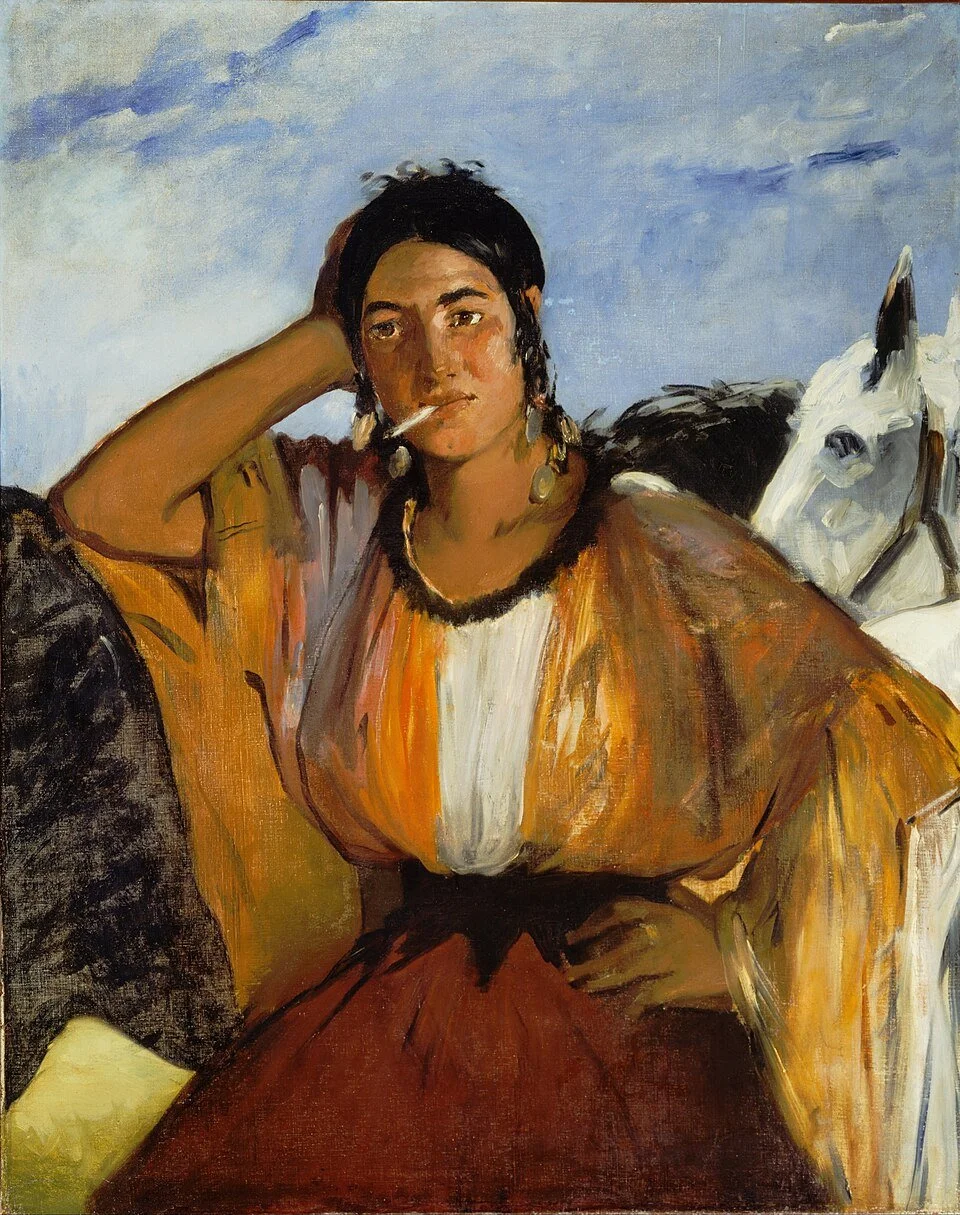
Alexandra Letvin is the inaugural Duane Wilder, Class of 1951, Curator of European Art at the Princeton University Art Museum, where she guides the program in European painting and sculpture from the medieval period to 1945. A specialist in the art of early modern Spain, Letvin’s projects at the Museum range widely and include the installation of the European galleries (2025) and an upcoming exhibition on Édouard Manet’s Woman with a Cigarette (2027).
Dr. Letvin will speak about her upcoming exhibition, Manet’s Bohémienne, which highlights the complex ways in which nineteenth-century French ideas of race and identity shaped the making and reception of one of Édouard Manet’s least understood paintings, now in Princeton’s collection. The exhibition disentangles the painting’s title and reception history to resituate the picture within Manet’s work and reconsider its subject, exploring Manet’s artistic practice and use of models, as well as nineteenth-century French perceptions of Spain and the Roma.
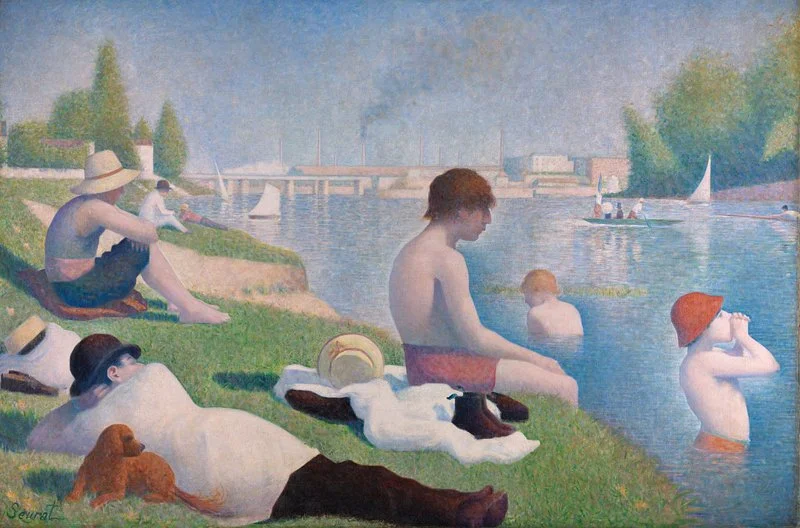
Summer Symposium: Lightning Talks
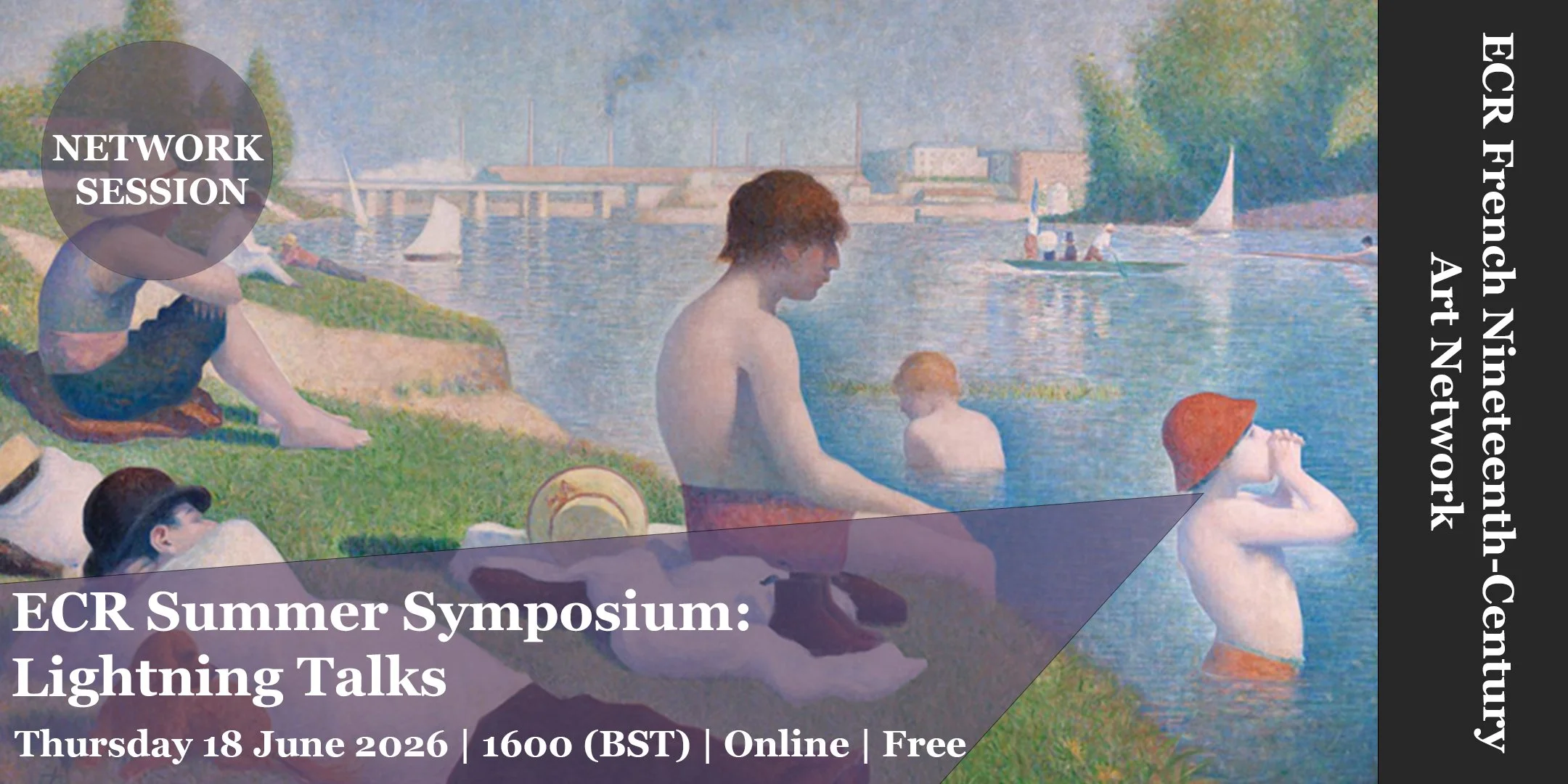
ECR French Nineteenth-Century Art Network presents:
ECR Summer Symposium: Lightning Talks
Thursday 18 June
1600 (BST) / 1700 (CEST) / 1100 (EDT) / 0800 (PDT)
As a wrap-up to the 2025–26 academic year, we are welcoming five speakers to give brief lightning talks (8–10 minutes) on an aspect of their current research related to Francophone visual and material culture within the long nineteenth century. These talks offer a platform for emerging scholars to workshop developing ideas and to engage with an informed, supportive audience, and we actively encourage presentations on projects that are still in progress. A brief, open discussion and Q&A will follow. Let’s spotlight their fantastic research and celebrate the start of summer!
Speaking will be:
“From Apollo to Hercules: Hypermasculine Bodies in the Envois de Rome, 1840s–1860s”
Viktoriia Bazyk is currently working on a dissertation that examines hypermasculine representations of masculinity in works produced by students of the Académie de France à Rome (the so-called envois de Rome) between the 1840s and the 1860s. In April, she undertook a research stay in Rome, conducting library research at the Bibliotheca Hertziana, consulting collections at the Villa Medici—the seat of the Académie, where the analyzed works were created—and studying major artworks across the city that may have informed these artists’ visual vocabularies and inspired their choice of subjects and archetypes. In her presentation, she will summarize her preliminary findings on how the plurality of styles and corporeal aesthetics available to viewers in the Eternal City may have prompted artists to depart from established academic ideals of the male nude.
Viktoriia Bazyk is a doctoral student at the University of Vienna, a research and teaching assistant at the Vienna Department of Art History and a fellow of the Vienna Doctoral School of Historical and Cultural Studies. In 2024, she was awarded the Sir-Ernst-Gombrich-Nachwuchspreis for her master’s thesis on transgressive masculinity in William Bouguereau’s painting Dante and Virgil in Hell. Currently, she is working on her PhD project entitled “Constructing hypermasculine masculinities: The envois de Rome and the academic male nude in mid-nineteenth-century France.” Her research interests include academic and salon painting in nineteenth-century France, gender and queer studies in art history, representations and constructions of masculinity in visual arts, and the nude as a means of artistic expression. Her most recent publication is “A Fresh Look at Muscular Masculinities” (Kunstchronik, April 2025).
“Painting Transcendence: Paul Baudry’s Ceiling for the Grand Foyer of the Palais Garnier”
Commissioned in 1861 during Baron Haussmann’s reconstruction of Paris, the Palais Garnier was conceived by Charles Garnier as a monument to imperial spectacle, artistic display, and social ritual. Central to this vision was the Grand Foyer, whose mirrored surfaces, gilded ornamentation, and monumental scale create an immersive environment intended to overwhelm and elevate the spectator. This talk examines Paul Baudry’s ceiling paintings in the Grand Foyer and argues that Baudry adapted the visual language of religious decoration to transform the Opéra into a modern site of transcendence. Through comparisons with the imagery of the Sistine Chapel and other Vatican interiors, the paper explores how Baudry adapted compositional arrangements and narrative modes associated with Vatican decoration to evoke the familiarity and authority of sacred space. By translating these conventions into a secular setting, Baudry reimagined the Palais Garnier as a temple of music and the arts, a space of spiritual elevation where spectacle itself became a transcendent experience.
Kelsey Yi Wing Yuen is a PhD candidate in the History of Art at the University of Cambridge. She holds a BA in History of Art and European Studies from the University of Hong Kong and an MLitt from the University of St Andrews. With academic and professional experience in both Hong Kong and the UK, her research focuses on nineteenth-century French art, architecture, and cultural history, with particular attention to the relationship between aesthetics, spectatorship, and social context. Supervised by Prof. Caroline van Eck, her doctoral project examines how the Paris Opéra Garnier stages spectacle through its architectural design, focusing on interpretive slippage in its reception from the Second Empire to the Third Republic.
“‘Pour s’instruire et pour s’amuser’: The Décennale of French Art at the 1889 Paris Exposition”
The state art exhibitions held as part of the Paris Expositions formed a key instrument of the Third Republic's cultural policy. Drawing on Ana Nasyrova’s dissertation project ‘In Pursuit of the Paris Salon: Official State Exhibitions in France, 1880–1900,’ this paper argues that, following the state’s withdrawal from the Paris Salon in 1880, it sought to establish a new national prestige exhibition in the form of the Décennale at the 1889 Exposition Universelle. However, despite the proclaimed ideals of a “Republic of the Arts,” the exhibition reinstated strategies of privileged exclusivity reminiscent of the Ancien Régime Salon system. By reaffirming genre hierarchies and favouring an older generation of academic painters, the state attempted to reassert its authority over artistic value and the general view of what should be considered high art.
Ana Nasyrova is an art historian and research associate at the Alte Nationalgalerie Berlin. She earned her master's degree in art and visual history at Humboldt-Universität zu Berlin (Humboldt University of Berlin), where she is currently pursuing her PhD with a dissertation titled “In Pursuit of the Paris Salon: Official Exhibitions in France, 1880–1900,” under the supervision of Prof. Dr. Claudia Blümle. Nasyrova specializes in nineteenth-century French and German art, with a particular interest in institutional history, political propaganda in the visual arts, and the changing definition and status of the visual arts under state influence.
“L’influence de la culture visuelle théâtrale de la fin du XIXe siècle sur l’illustration des pièces dans les éditions bibliophiliques”
Cette communication se propose d’explorer le constat suivant : le commerce de l’édition de luxe, qui connaît son âge d’or dans la première moitié du XXe siècle, publie une sélection récurrente de pièces de théâtre ayant rencontré un grand succès à la fin du XIXe siècle et intègre directement des éléments de ces mises en scène phares dans de riches programmes d’illustration. Ces citations visuelles témoignent de l’impact d’une industrie théâtrale toujours plus forte à la fin du siècle, qui s’exprime avant tout par l’image, qu’il s’agisse de la presse spécialisée ou des objets de memorabilia. Ce phénomène interroge ainsi la manière dont la culture visuelle théâtrale se prolonge au-delà de l’événement scénique et contribue à cristalliser un imaginaire, fixant durablement le mythe autour de certaines œuvres et de leurs interprètes. Une attention particulière sera portée à Pelléas et Mélisande, illustré par Carlos Schwabe, afin d’observer ces phénomènes de réinterprétation iconographique. Il s’agira de réfléchir aux processus de circulation transmédiatique et d’influence des images théâtrales sur l’illustration éditoriale.
Bérangère Juban est doctorante en première année d’histoire de l’art à l’université Paris 1 Panthéon-Sorbonne, au sein du laboratoire HICSA, sous la codirection de Catherine Méneux et de Mireille Losco-Lena. Ses recherches, qui prolongent un travail de master réalisé à l’université Lumière Lyon 2, portent sur la culture visuelle théâtrale de la fin du XIXe siècle et son influence sur l’illustration dans les éditions bibliophiliques. Elle s’intéresse aux circulations et aux transpositions de modèles visuels entre différents médias. Ses travaux s’inscrivent à la croisée des études sur la culture visuelle, de l’histoire du livre et des études théâtrales.
“Reimagining Versailles: Elsie de Wolfe and the Interiors of Villa Trianon”
Sara's doctoral dissertation examines the life and work of American-born, French-dwelling decorator Elsie de Wolfe, with a chapter focusing on her 1905 acquisition and redesign of Villa Trianon, an estate near the Château de Versailles. Framed within the long nineteenth century (1789–1914), this chapter traces de Wolfe’s fascination with French history and culture, particularly her obsession with Marie Antoinette and the spatial imaginaries of Versailles, including the Petit Trianon and the Temple of Love, and considers how these were visually and materially reinterpreted in her own home. The proposed talk draws on archival documents from the Archives communales de Versailles (letters, building plans, and related ephemera) and object-based research at the Cooper Hewitt Smithsonian Design Museum (furniture and textile samples) to elucidate the relationship between these historical sites and de Wolfe’s interiors. As a work in progress, it explores how stylistic revivals operate across this extended temporal frame.
Sara Shields-Rivard (she/her) is a PhD candidate in Art History at Queen’s University (Canada). Her dissertation examines the gendered and racial implications of Elsie de Wolfe’s life and design work, situating her practice through the transnational contexts of the places she lived and travelled—Canada, the United States, France, and India—and through her connections to other creative women, including Elsa Schiaparelli and Princess Sita Devi of Kapurthala. Her research on this topic can be found in Dwelling at the Margins of Empire: Global Perspectives of Home (2025) and in the forthcoming "Special Issue: Domestic" of the Interiors journal.
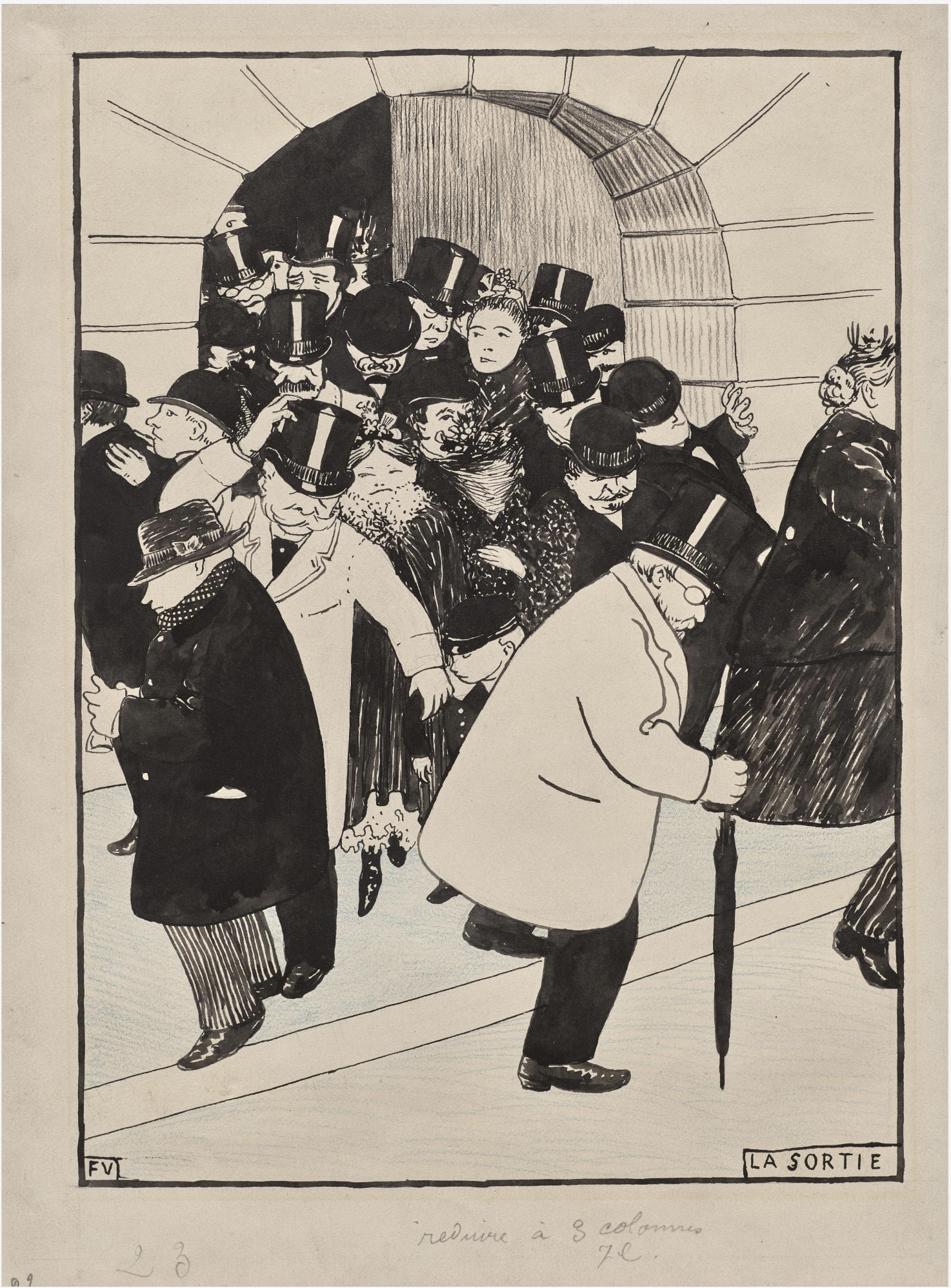
Curatorial Roundtable: New Acquisitions on Paper

ECR French Nineteenth-Century Art Network presents:
Curatorial Roundtable: New Acquisitions on Paper
Thursday 28 May
17:00 (BST) // 18:00 (CEST) // 12:00 (EDT) // 09:00 (PDT)
Museums help to protect, care for, and further the knowledge of a variety of works on paper, treasured objects that are rarely on view. They play an important role in the history of art, but often get overlooked by the larger canvases that dominate the more public spaces of museums. Yet, curators continually seek to enhance the depth and scope of their works on paper collections through donations and purchases, made possible through a range of funds, sponsors, and benefactors. This Network Session will bring together four curators to spotlight some of their recent acquisitions across prints, drawings, and other works on paper. The panel will discuss the works acquired as well as how the work enhances their respective collections and the ways in which curators seek to shape their collections. This session will feature four curators at notable institutions—highlighting some lesser-known artists and works— to celebrate the invaluable efforts undertaken to acquire, research, and care for works on paper.
Participating will be:
Ashley E. Dunn is an associate curator in the Department of Drawings & Prints at The Metropolitan Museum of Art, where she is responsible for nineteenth-century French works on paper. Her recent exhibitions at The Met include Fanmania (2025) and Manet/Degas (2023). Earlier projects focused on drawings by Delacroix and Rodin. She holds a BA in French from Emory University, MSt in the history of art and visual culture from the University of Oxford, and PhD from Northwestern University (2019).
Britany Salsbury is Curator of Prints and Drawings at the Cleveland Museum of Art. She previously held positions related to works on paper at The Metropolitan Museum of Art, RISD Museum, and Milwaukee Art Museum, among others. Her exhibitions and publications include Degas and the Laundress: Women, Work, and Impressionism (2023), Nineteenth-Century French Drawings from the Cleveland Museum of Art (2023), and Altered States: Etching in Late 19th-Century Paris (2016). Her research has been published in Nineteenth-Century Art Worldwide and Print Quarterly, and she co-edited the book Collecting Prints, Posters, and Ephemera: Perspectives in a Global World (2019).
Natalia Lauricella is Curator of Prints and Drawings at the Achenbach Foundation for Graphic Arts, Fine Arts Museums of San Francisco. A specialist in 19th-century prints with a doctorate in art history from the University of Southern California, Natalia joined the Fine Arts Museums of San Francisco in 2024. Previously, she was a fellow in the Department of Art & Art History at Stanford University and held positions at MoMA and the Guggenheim in New York. Her recent exhibitions at FAMSF include Matisse’s Jazz Unbound and Printing Color: Chiaroscuro to Screenprint, and she is developing a large exhibition on Henri de Toulouse-Lautrec.
Danielle Canter is Assistant Curator in the Department of Drawings at the J. Paul Getty Museum, where she is responsible for the care and presentation of French drawings and the pastel collection. Her exhibition projects include Exploring the Alps (2024), A Brush with Nature: Romantic Landscape Drawings (2025), and the upcoming Odilon Redon: Otherworldly Visions (2026). Before joining the Getty, Danielle held fellowships at the Metropolitan Museum of Art, the Philadelphia Museum of Art, and the Cleveland Museum of Art. She received her M.A. in the History of Art from Williams College and is now completing her Ph.D. at the University of Delaware.
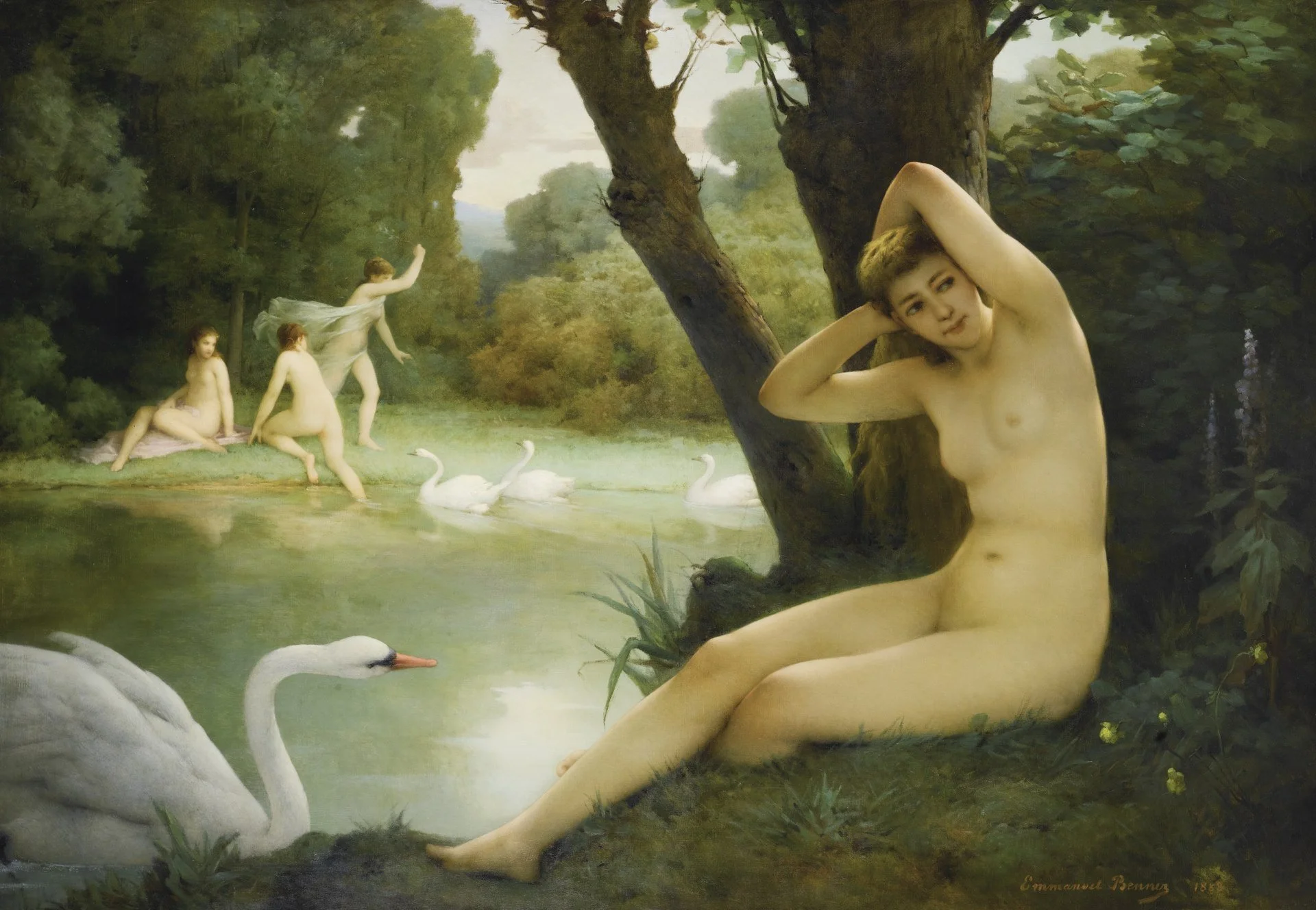
Mettre en image les violences au XIXe siècle

ECR French Nineteenth-Century Art Network presents:
Mettre en image les violences au XIXe siècle
Thursday 30 April,
18:00 (CEST) // 17:00 (BST) // 12:00 (EDT) // 09:00 (PDT)
This Network Session will be in French but Q&A will be in both French and English—feel free to come and ask your questions in the language you prefer!
Cette séance propose une réflexion sur la transversalité des violences dans la France du long XIXe siècle en mettant en regard les violences sexuelles envers les femmes et les violences qui sous-tendent les représentations animales. À partir de corpus d’images et de textes, les deux interventions interrogent les régimes de représentation et les logiques de domination qui structurent l’imaginaire visuel de la période. En prenant pour point de départ deux objets distincts — les représentations mythologiques impliquant le corps féminin et la production d’images animales dans le contexte du développement des sciences naturelles — cette séance invite à penser la violence comme un phénomène structurel qui traverse les discours, les pratiques et les formes artistiques. Elle s’intéresse en particulier aux cadres visuels et discursifs qui rendent certaines violences représentables, pensables ou, au contraire, difficiles à nommer.
–
This session offers a reflection on the transversality of violence in long nineteenth-century France by juxtaposing depictions of sexual violence against women with representations of animals underpinned by forms of violence. Drawing on corpora of images and texts, two papers will examine the regimes of representation and the structures of domination that shaped the visual imagination of the period. Taking as their starting point two distinct subjects—mythological representations of the female body and the production of animal imagery in the context of the natural sciences—the session invites us to consider violence as a structural phenomenon that cuts across discourses, practices, and artistic forms. Particular attention is given to the visual and discursive frameworks that render certain forms of violence representable and thinkable, while making others difficult to name.
Intervenantes / Speakers :
Mathilde Leïchlé (Université Paris Cité / CERILAC) : “Violences sexuelles, iconologie et métamorphoses animales (France, second XIXe siècle)”
Entre 1857 et 1908, cent trente œuvres exposées aux Salons parisiens traitent explicitement du thème de Léda et le cygne tandis que d’autres l'évoquent en créant une porosité entre le mythique et le contemporain, phénomène tout à fait représentatif du rapport aux mythes des artistes de ce temps. Des cimaises des Salons aux dessins de presse, des romans aux traités de médecine légale, nous verrons dans quelle mesure cet épisode est choisi pour représenter d’une façon plus explicite un accouplement qui est, en réalité, un viol opéré par surprise. Alors que le corps animal permet de signifier la pénétration et le pénis en évitant la censure, plusieurs stratégies d’évitement sont développées par les critiques et écrivains pour ne pas dire ce viol.
Biographie : Doctorante en histoire et sémiologie du texte et de l’image, Mathilde Leïchlé prépare une thèse sur les images et imaginaires des violences sexuelles faites aux femmes et aux filles en France entre 1857 et 1908 (Université Paris Cité / CERILAC). De 2021 à 2025, elle a été chargée d’études et de recherche à l’Institut national d’histoire de l’art. Elle a auparavant travaillé pour plusieurs institutions (Davis Museum, Musée d’Orsay…) et a collaboré à diverses publications (catalogues d’exposition, revues scientifiques, répertoire biographique d’AWARE…). Elle a également co-dirigé le numéro de la revue GLAD! sur les Constellations créatrices (2022) et le Brouillon pour une encyclopédie féministe des mythes (2023, éditions iXe).
Dr. Marie-Charlotte Leïla Lamy (Universität Basel) : “Quelles violences sous-tendent la fabrication de l’image animale ?”
Les êtres non-humains envahissent la culture visuelle du XIXe siècle, devenant davantage visibles avec l’émergence des zoos et des musées d’histoire naturelle. Cette production picturale montre un réel intérêt pour la reconstitution de l’animal vivant et en mouvement, toutefois fabriquée à partir de modèles captifs, voire morts ou encore fragmentés par la dissection anatomique. Lors de cette intervention, il sera question de s’interroger sur les conditions imposées aux animaux pour pouvoir tirer leur portrait, en retraçant leur parcours de l’extraction de l’habitat naturel jusqu’à l’implantation dans des enceintes de monstration.
Biographie : Marie-Charlotte Lamy est PostDoc à l’Université de Bâle dans le projet de recherche FNS Killing to Keep – Violent Field Practices and Natural History in the Age of Empire. Ses recherches et ses publications sont consacrées à la relation humain-animal et l’histoire de la zoologie par l’étude de la culture visuelle et matérielle. Elle a réalisé une thèse de doctorat sous la direction de Valérie Kobi (Université de Neuchâtel) et d’Ersy Contogouris (Université de Montréal), intitulée Animal impérial. Conquérir (par) le savoir zoologique dans les ménageries postrévolutionnaires et soutenue à l’été 2025 à l’Université de Neuchâtel.
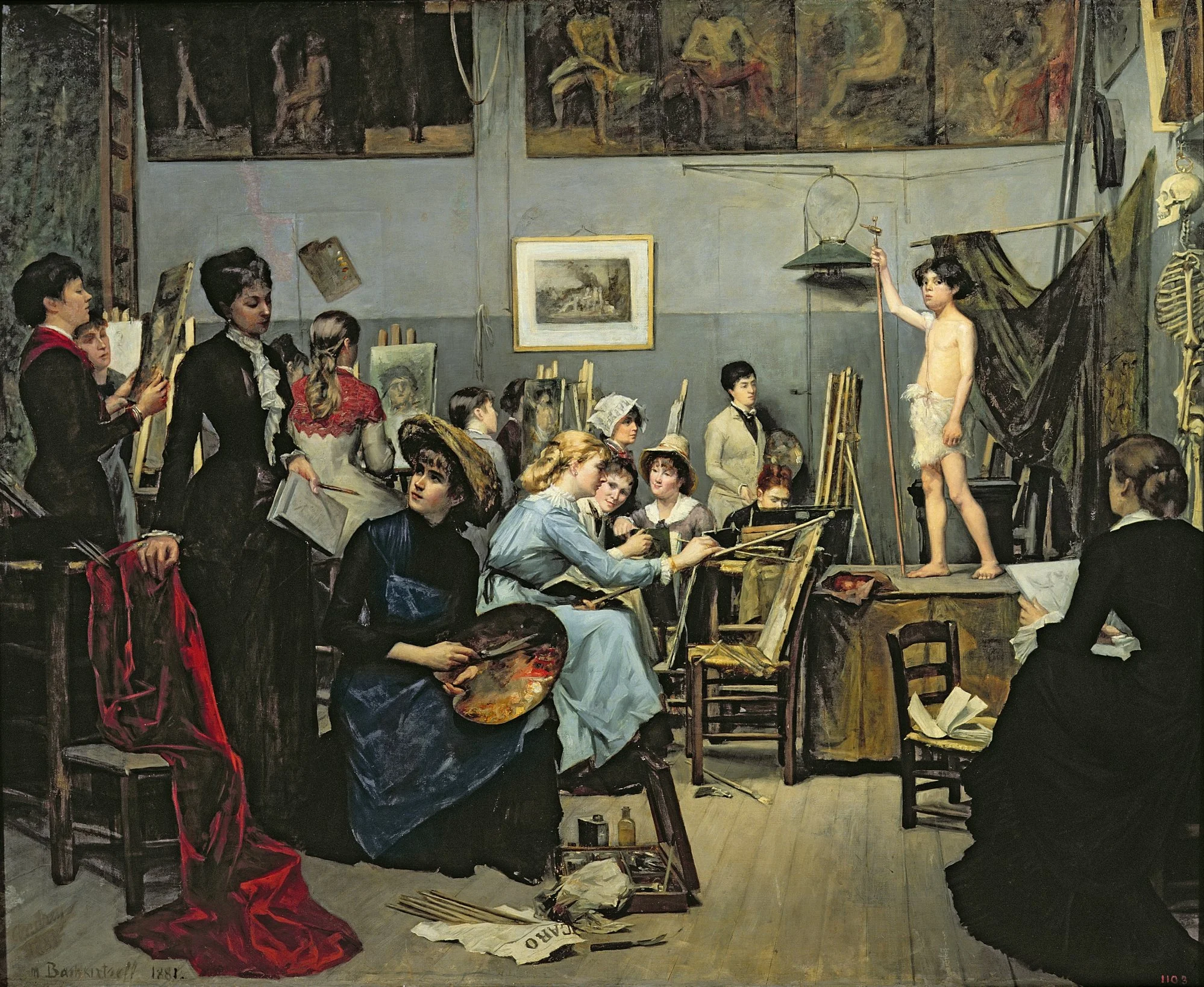
Roundtable: Demystifying Fellowships
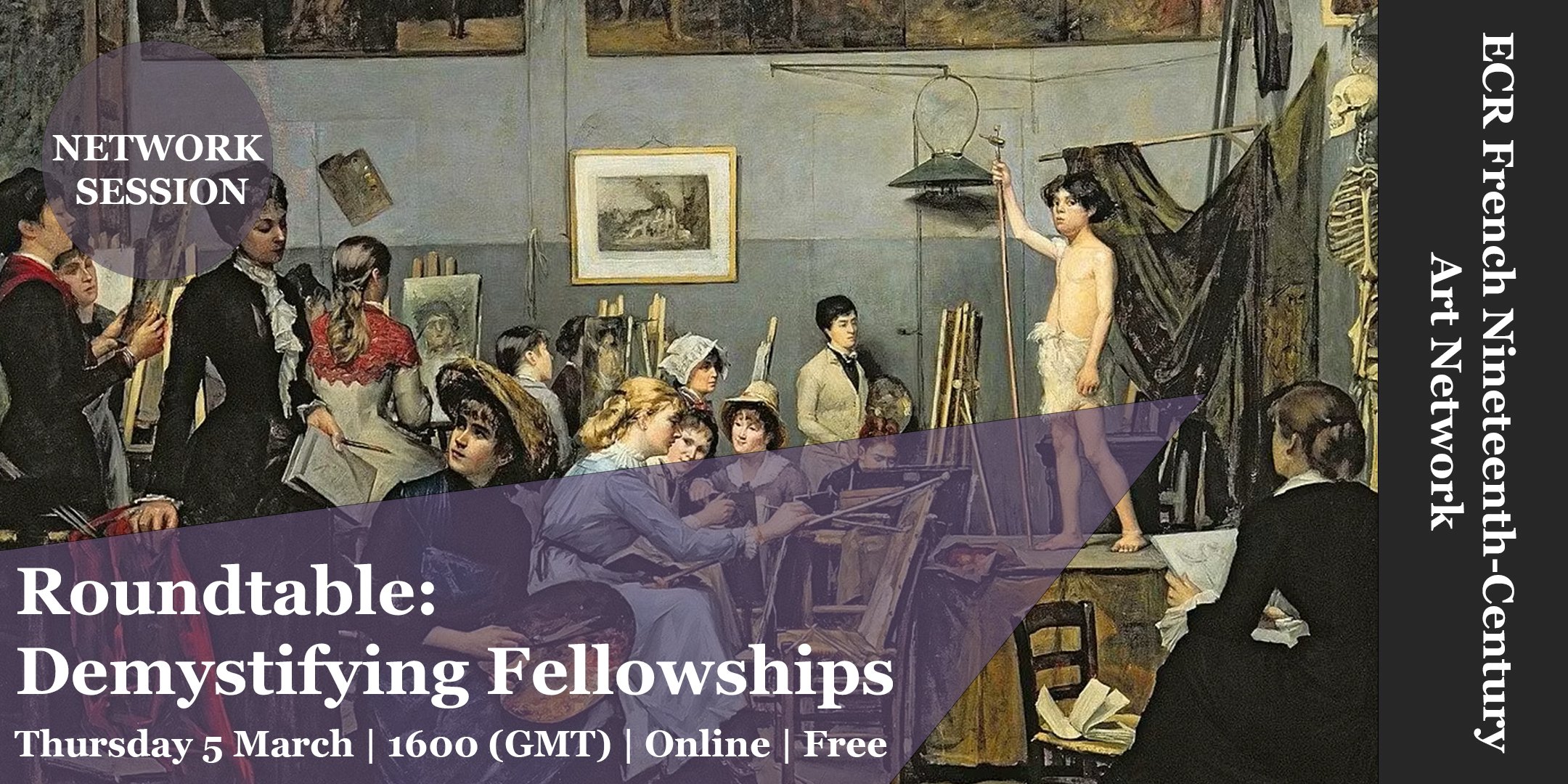
ECR French Nineteenth-Century Art Network presents:
Roundtable: Demystifying Fellowships
Thursday 5 March 2026
0800 PST / 1000 CST / 1100 EST / 1600 GMT / 1700 CET
As early-career researchers, we are constantly scrambling for sources of funding and institutional support. Although applying for pre- and post-doctoral fellowships is something we are all faced with at some point, the process of finding the right fit, building a strong application, and getting the most out of the experiences we’re offered is rarely discussed. Join us as we break down the myths and mystique of fellowships in both academia and museums across Europe and North America. Our panelists will share their wide range of experiences, so come prepared with questions!
We are fortunate to be joined by four speakers:
Annabel Bai Jackson, Dorset Curatorial Fellow for Modern & Contemporary Projects, National Gallery
Annabel is the Dorset Curatorial Fellow for Modern & Contemporary Projects at the National Gallery, where she works on post-1800 paintings and the contemporary art programme. Recent projects include Ming Wong: Dance of the sun on the water (2026), Radical Harmony: Helene Kröller-Müller’s Neo-Impressionists (2025/6), and Katrina Palmer: The Touch Report (2024/5). She was previously Curatorial Assistant at the Barbican Centre, where she contributed to Alice Neel: Hot Off the Griddle (2023). She earned her MSt in English 1900-present from the University of Oxford and has written for Apollo, Sight & Sound, Oxford Review of Books, among others.
Marina Kliger, Rousseau Curatorial Fellow in European Art, Harvard Art Museums
Marina Kliger earned her PhD from the Institute of Fine Arts at NYU in 2020 with a dissertation on the Troubadour Style and gendered historical consciousness in early nineteenth-century France. Her research abroad was supported by the Société des Professeurs Français et Francophones d’Amérique (Bourse Jeanne Marandon, 2016-2017), as well as fellowships administered by NYU. She was the inaugural Eugene V. Thaw Fellow for Collections Cataloging at the Metropolitan Museum of Art (2020–2022) and the Rousseau Curatorial Fellow in European Art at Harvard Art Museums (2022-2026), where she co-curated The Solomon Collection: Dürer to Degas and Beyond (May-August 2025).
Jennifer Laffick, PhD Candidate, Southern Methodist University
Jennifer is an art history PhD Candidate at Southern Methodist University in Dallas, Texas. Her research focuses on the relationship between French art and empire in the years surrounding 1800. For her dissertation, “Neoclassicism’s Atlantic Currents: French Painting and Power in the Early Nineteenth Century,” Laffick has received a Fulbright Research Grant (France), a Chateaubriand Fellowship, the Gilbert Chinard Fellowship from the Society for French Historical Studies, and a Mary Vidal Memorial Award from the Historians of Eighteenth-Century Art and Architecture. Later this spring, Laffick will be in residence as a Fellow at the John Carter Brown Library.
Nicholas Parkinson, Lecturer, Art History and English, Université Paris Panthéon-Sorbonne
Nicholas is an art historian (PhD, Stony Brook University) whose research explores the intersection of art, politics, and globalization in the nineteenth century. His upcoming book, Commemorating Defeat: Viral Monuments and the International Cult of the Lost Cause, will be published by Central European University Press in the spring of 2026.
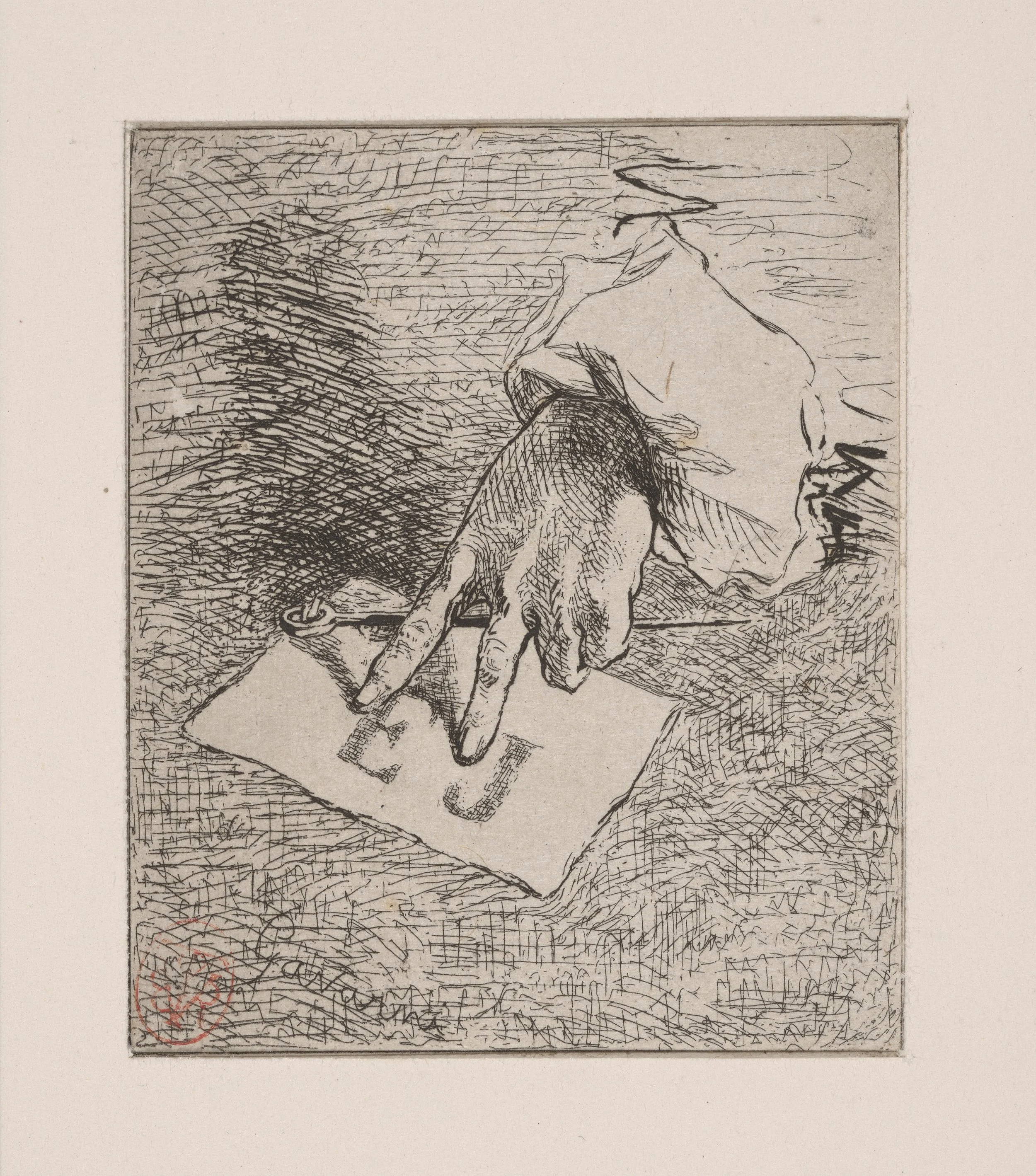
From Print to Prose: The Goncourt Brothers and the Language of Etching

ECR French Nineteenth-Century Art Network Research Forum:
From Print to Prose: The Goncourt Brothers and the Language of Etching
Dr. Rachel Skokowski, Janet Turner Print Museum, California State University, Chico
Wednesday 25 February 2026
1700 (GMT) // 1800 (CET) // 1200 (EST) // 0900 (PST)
Known as novelists, diarists, art historians, and collectors, Jules and Edmond de Goncourt were also printmakers, producing nearly 100 etchings from 1859 until Jules’s untimely death in 1870. Over the same decade, the brothers were active participants in the French etching revival, a movement that brought together artists and writers to theorize printmaking in new ways. This talk identifies new intersections between prints and prose in the Goncourts’ wide-ranging work. Using an interdisciplinary approach that centers the embodied processes of etching and writing, this research explores how consideration of the brothers’ firsthand experience with printmaking sheds new light on pressing questions about reproduction, imitation, and originality in nineteenth-century French art.
Rachel Skokowski is the Director of Galleries and Curator of the Janet Turner Print Museum at California State University, Chico. She received her PhD from the University of Oxford, where she studied as a Rhodes Scholar, and she holds an MSt from Oxford and a BA from Princeton University. Her first book, The Goncourt Brothers and the Language of Etching, was published by Oxford University Press in November 2025. Her research on nineteenth-century French print culture has previously appeared in Nineteenth-Century French Studies and the Australian Journal of French Studies.
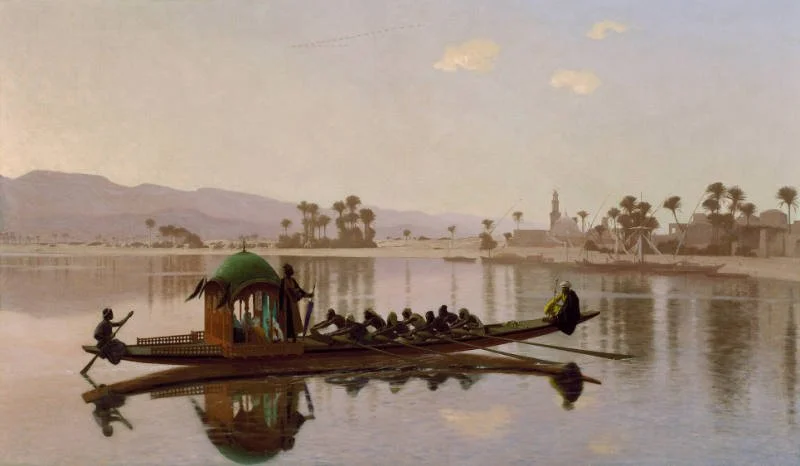
Doubly Other: Black Harem Eunuchs in Gérôme’s Orient
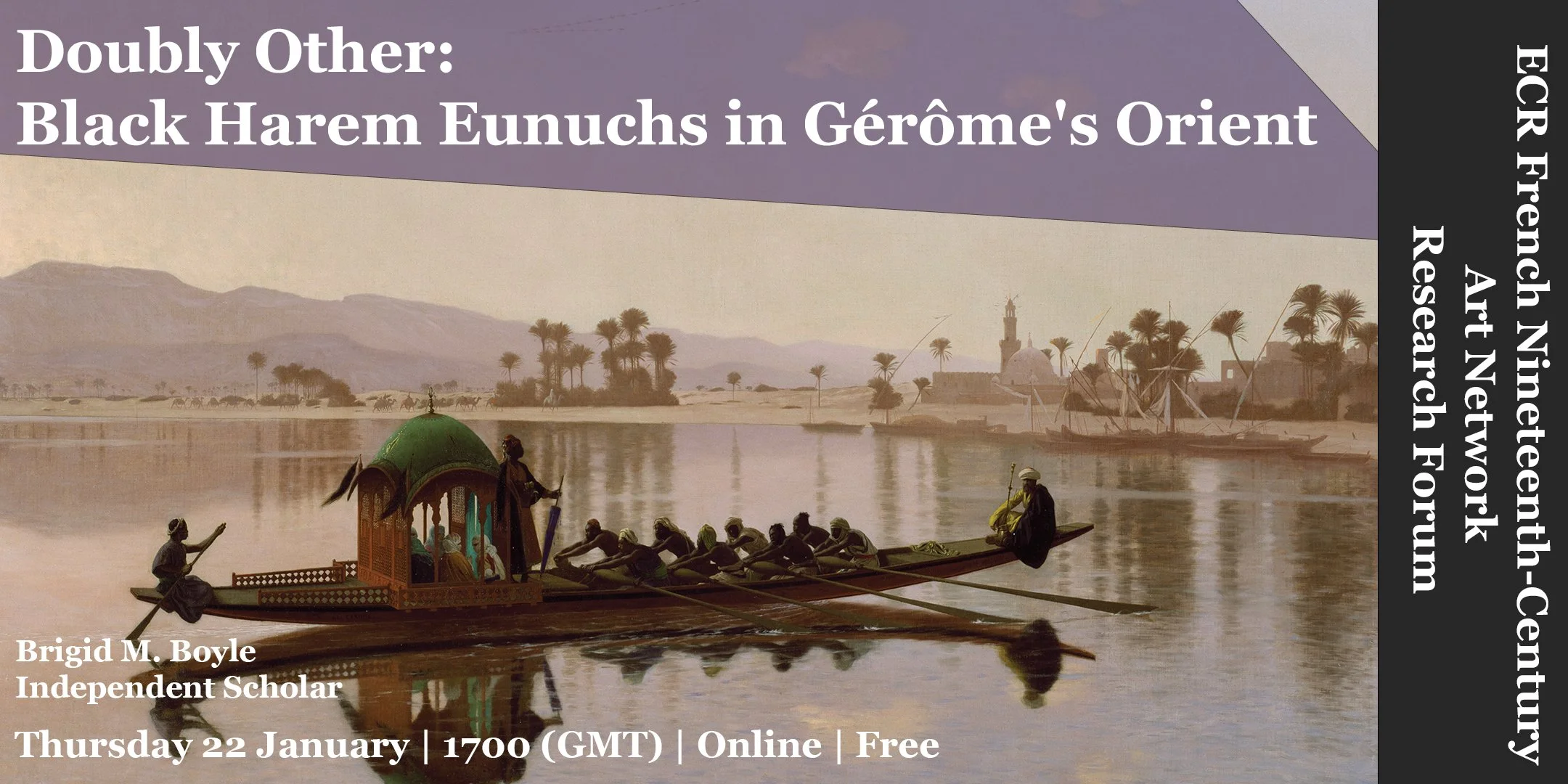
ECR French Nineteenth-Century Art Network Research Forum:
Doubly Other: Black Harem Eunuchs in Gérôme’s Orient
Dr. Brigid M. Boyle, independent scholar
Thursday 22 January 2026
1700 (GMT) // 1800 (CET) // 1200 (EST) // 0900 (PST)
Enslaved Black eunuchs were ubiquitous in the Ottoman Empire from the early sixteenth to late nineteenth centuries. They performed a wide range of jobs but were most famous for overseeing female harems thanks to literary works like Montesquieu’s Persian Letters (1721). Orientalist artists often portrayed them as privileged insiders mingling with odalisques in exotic interiors or as hypermasculine armed guards standing sentry at harem thresholds. Jean-Léon Gérôme (1824–1904), however, mostly eschewed these visual conventions. Between 1859 and 1894, he produced three plein-air harem scenes that depict Black eunuchs out in the world, publicly chaperoning the sultan’s wives and concubines. This talk will consider these works as a group to reveal Gérôme’s efforts to demystify and de-eroticize Black harem eunuchs.
Brigid M. Boyle received her PhD in Art History from Rutgers University in 2024. She specializes in French art of the long nineteenth century, with particular expertise in Orientalism. Her dissertation examined Jean-Léon Gérôme’s representations of Black soldiers, performers, animal workers, and eunuchs in relation to period discourse on race and gender. She previously served as Bloch Family Foundation Doctoral Fellow at the Nelson-Atkins Museum of Art, where she co-launched the digital collection catalogue French Paintings and Pastels, 1600–1945. Her writing has appeared in Male Bonds in Nineteenth-Century Art (2021) and Winterthur Portfolio, and she is currently co-editing the first critical edition of Gérôme’s correspondence.
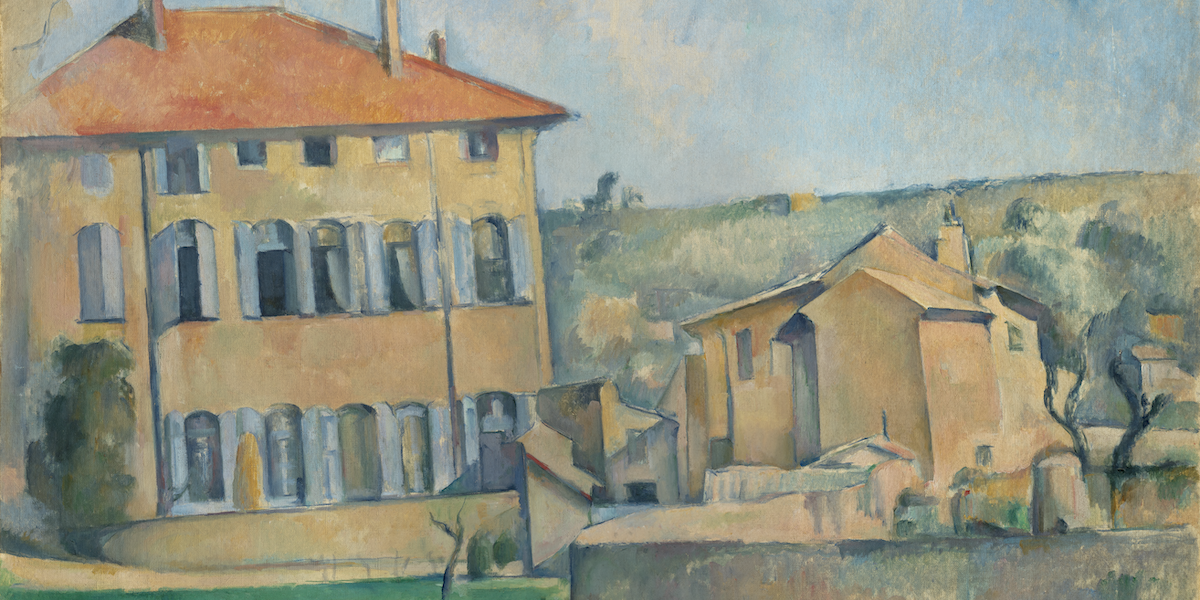
Cezanne 2025: New Directions in Cezanne Studies
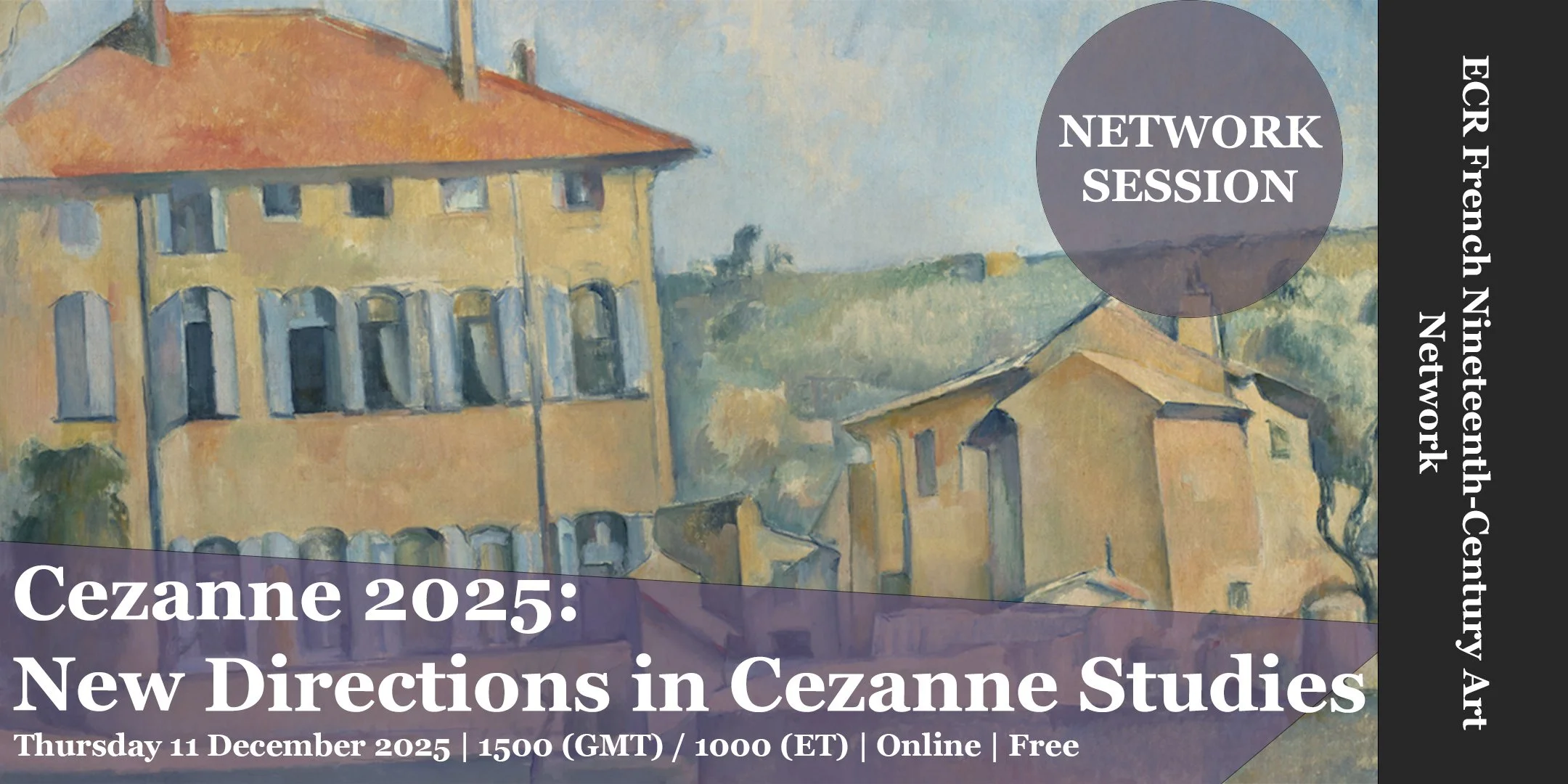
ECR French Nineteenth-Century Art Network presents:
Cezanne 2025: New Directions in Cezanne Studies
Thursday 11 December 2025
1500 (GMT) // 1600 (CET) // 1000 (EST) // 0700 (PST)
** Please note the rescheduled date **
2025 has been a pivotal year for Cezanne studies, with a variety of projects, exhibitions, and scholarly research all coming to fruition. Currently centered on Aix-en-Provence, these include, but are not limited to, the current exhibition Cezanne au Jas de Bouffan taking place at the Musée Granet (Aix-en-Provence), the restoration of both the artist’s family home (the Bastide du Jas de Bouffan) and his final studio, the Atelier des Lauves. 2026 marks the 120th anniversary of his death and will see further projects materialise such as such as the Art Institute of Chicago’s long-awaited online scholarly catalogue of works by Cezanne. This Network Session will be a chance to explore the present and future of Cezanne studies. Drawing upon scholars, curators, and conservators working across a variety of projects, this session will not only illuminate the wealth of research brought forth from these endeavours, but also their interconnectedness and future opportunities that will advance and expand studies around this thoroughly modern artist.
Speaking will be:
Kathryn Kremnitzer joined Sotheby’s in June 2021, where she is now a consultant based in France. She earned her PhD at Columbia University in 2020 with a dissertation that explored how Édouard Manet worked across media in the 1860s. She was previously Research Associate in the Painting and Sculpture of Europe department at the Art Institute of Chicago, where she worked on Manet and Modern Beauty (2019), Monet and Chicago (2020), and Cezanne (2022), and contributed to the online scholarly catalogue of Manet’s works in the collection. As a Curatorial Assistant at The Metropolitan Museum of Art, she worked on Madame Cézanne (2014) and Tiepolo Caricatures from the Robert Lehman Collection (2014). She is a member of the Société Paul Cezanne and contributed to the catalogue accompanying the Musée Granet’s current exhibition, Cezanne au Jas de Bouffan.
Jean-Rémi Touzet est auteur d’une thèse sur l’œuvre de Gerhard Richter à l’Université Paris Nanterre, Jean-Rémi Touzet a été conservateur au Musée d’arts de Nantes avant de rejoindre le Musée d’Orsay en tant que conservateur peinture. Il a été le commissaire des expositions Le Voyage en train (Musée d’arts de Nantes, 2022) et Post-Impressionnisme. Au-delà des apparences (Louvre Abu Dhabi, 2024). Il a récemment contribué aux catalogues des expositions Dans le flou (Musée de l’Orangerie, 2025) et Sous la pluie, peindre, vivre et rêver (Musée d’arts de Nantes, 2025).

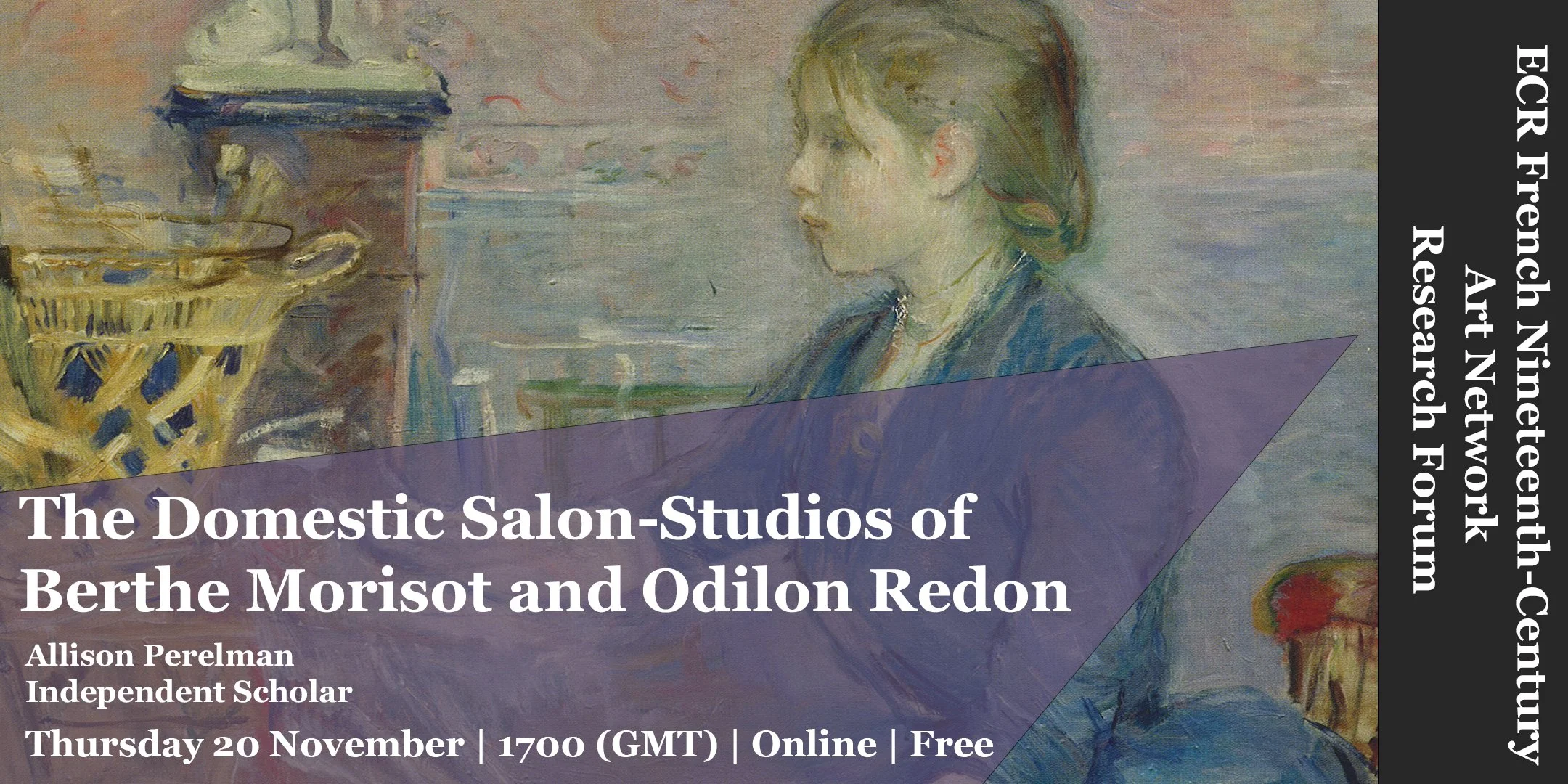
The Domestic Salon-Studios of Berthe Morisot and Odilon Redon
ECR French Nineteenth-Century Art Network Research Forum:
The Domestic Salon-Studios of Berthe Morisot and Odilon Redon
Dr. Allison Perelman, independent scholar
Thursday 20 November 2025
1700 (GMT) // 1800 (CET) // 1200 (EST) // 0900 (PST)
At the height of their careers, neither Berthe Morisot (1841–1895) nor Odilon Redon (1840–1916) employed a separate workroom as a studio. Instead, each produced art in spaces coextensive with the domestic salons of their family residences. Despite the parallel use of salon-studios, Morisot’s and Redon’s contemporaries interpreted their arrangements in distinct terms, initiating patterns that have since been perpetuated in much scholarship. Morisot’s peers aligned her domestic setting with the traditional practices of amateur women artists. In contrast, Redon’s supporters equated this arrangement to writers’ habits of working at home, thus recasting the salon-studio as a manifestation of his literary tendencies. By analyzing their studios together, this talk provides a more nuanced understanding of the shared values between aesthetically disparate, but equally innovative artists of separate gender identities. Moreover, it sheds light on Morisot’s own agency and her deft navigation of the codes of behavior imposed on bourgeois women of her time.
Allison Perelman completed her dissertation, “Private Space, Public Self: Studios of the Avant-Garde in Fin-de-Siècle France,” and earned her PhD from Washington University in St. Louis in May 2025. Prior to her graduate studies, she served as the dedicated research associate for nineteenth-century exhibitions in the Department of Painting and Sculpture of Europe at the Art Institute of Chicago, including Van Gogh’s Bedrooms (2016) and Gauguin: Artist as Alchemist (2017). Her writing has been published by the Art Institute of Chicago, the Musée d’Orsay, the Nelson-Atkins Museum, Oxford University Press, and Thames & Hudson.

Curatorial Roundtable: Radical Harmony

ECR French Nineteenth-Century Art Network presents:
Curatorial Roundtable: Radical Harmony
Tuesday 14 October
1600 (BST) // 1700 (CEST) // 1100 (EDT) // 0800 (PDT)
Radical Harmony is the first significant exhibition of Neo-Impressionist works to take place at the National Gallery, London. Emerging from the final Impressionist exhibition in 1886, Neo-Impressionism lasted into the twentieth century—well past the death of its chief proponent, George Seurat—and extended beyond Paris to Saint-Tropez, Brussels, and the Netherlands. Early in the twentieth century, Helene Kröller-Müller (1869–1939) assembled perhaps the world’s greatest and most comprehensive collection of Neo-Impressionist paintings. This Curatorial Roundtable will bring together three of the key exhibition contributors to discuss how Radical Harmony celebrates the legacy of both the Neo-Impressionist movement and of Kröller-Müller as a leading collector of modern art. Our speakers will highlight the conception of the exhibition, installation, and process of selecting works, drawing from the Kröller-Müller Museum’s permanent collection as well as a judicious selection of loans from other European and American public and private collections. This roundtable discussion will explore the Neo-Impressionists’ art and society as well as the extent to which Kröller-Müller shaped the collecting and exhibiting of this movement, an impact still seen today.
Julien Domercq is Curator at the Royal Academy of Arts, London, where he is responsible for nineteenth-century and old masters’ exhibitions. There he recently curated Kiefer/Van Gogh (2025), and co-curated Michelangelo, Leonardo, Raphael: Florence, c. 1504 (2024–25) and is currently developing a variety of nineteenth- and early twentieth-century projects. He previously worked at the National Gallery, London, where he co-curated After Impressionism: Inventing Modern Art (2023) and Drawn in Colour: Degas from the Burrell (2017–18).
Renske Cohen Tervaert is Curator at the Kröller-Müller, Otterlo, the Netherlands. She holds an MA in Art History from the University of Amsterdam. She specialises in visual arts at the end of the nineteenth and early twentieth centuries, with a specific interest in Vincent van Gogh and the history of collecting and the international art market.
Annabel Bai Jackson is the Dorset Curatorial Fellow for Modern and Contemporary Projects at the National Gallery, London, where she works on post-1800 paintings and the contemporary art programme. She previously worked at the Barbican Centre as a Curatorial Assistant and holds an MA in English (1900-present) from the University of Oxford. As a writer, she has contributed to Apollo, Sight & Sound, and The Oxford Review of Books.

Curatorial Roundtable: The National Gallery at 200. Re-hanging the 19th and 20th centuries

ECR French Nineteenth-Century Art Network Network Session
“Curatorial Roundtable: The National Gallery at 200. Re-hanging the 19th and 20th centuries”
Thursday 19 June 2025,
1600 BST // 1700 CEST // 1100 EDT // 800 PDT
For the first time since the Second World War, the National Gallery, London, is undertaking a complete rehang of its collection. As the grand finale of the museum’s year-long bicentenary celebrations, this gallery-wide rethinking of the collection—The Wonder of Art—opens on 10 May 2025. Spanning from the 13th to the early 20th century, the Gallery’s holdings of Western Art include many notable examples of nineteenth-century French painting, such as Édouard Manet's The Execution of Maximilian, Georges Seurat’s Bathers at Asnières, and Paul Cezanne’s Bathers. While the narrative remains broadly chronological, the installation will now be punctuated by thematic rooms that are both transnational and transhistorical, focusing on specific media or artistic genres.
This network session will offer an opportunity to look behind the scenes of this major project; to hear directly from two curators who have brought these ideas to life; and to discover the many considerations that inform a hang, from conservation through to design aesthetics. Learn about the curatorial discussions behind the new display: Which were the key factors behind the main decisions? And how did design solutions impact the hang?
Speaker Bios:
Sarah Herring is Associate Curator of Post-1800 paintings at the National Gallery, London. She has a particular interest in landscape and published The Nineteenth Century French Paintings. Volume 1, The Barbizon School (2019), part of the series of National Gallery Schools Catalogues. With Emma Capron, she was co-curator of the exhibition Discover Manet and Eva Gonzalès (2022–23), which explored a number of themes around Manet’s imposing portrait, including the education and position of women artists in the nineteenth century. She is the curator of a focused exhibition devoted to Jean-François Millet (7 August–19 October 2025).
Dr Chiara Di Stefano is Associate Curator of Post-1800 Paintings at the National Gallery, London. She received her PhD from the Sorbonne University in Paris, with a thesis focusing on the impact of prehistoric art on twentieth-century artists. Before joining the National Gallery, she worked at the Centre Pompidou – Musée National d’Art Moderne, Paris, where she collaborated on a redisplay of the permanent collection and on the exhibition Prehistory: A modern enigma (2019). In the past ten years, she published extensively on modern art and the history of collecting. At the National Gallery, she co-curated with Anne Robbins the exhibition Degas and Miss La La (2024). She is currently co-curating Radical Harmony: Helene Kröller-Müller’s Neo-Impressionists (13 September 2025–8 February 2026).
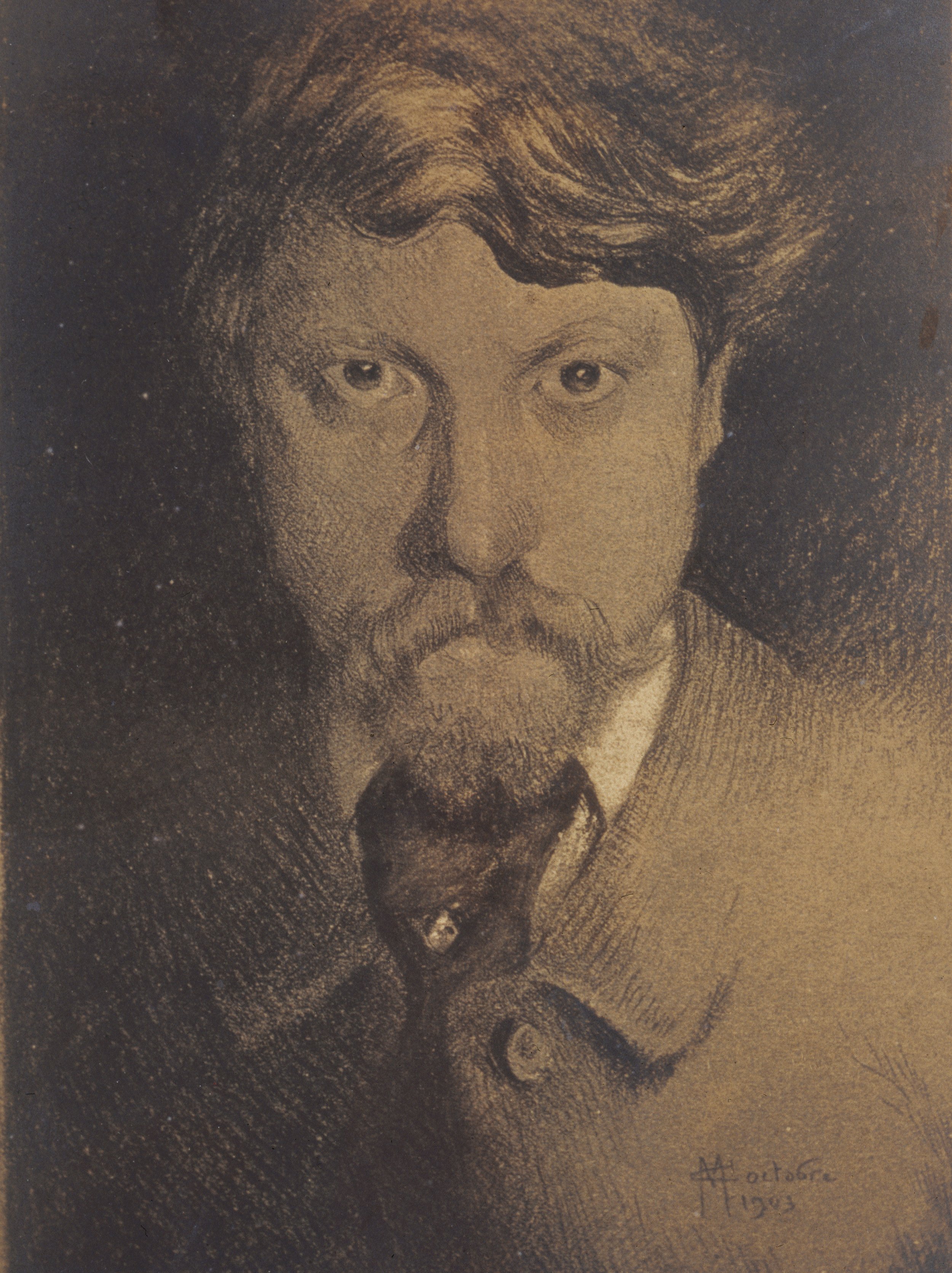
Camille Mauclair and the Shaping of Impressionism: Critical Strategies and Networks before and after World War One

ECR French Nineteenth-Century Art Network Research Forum:
Camille Mauclair and the Shaping of Impressionism: Critical Strategies and Networks before and after World War I
Dr. Katia Papandreopoulou - University of Patras, Greece
Wednesday 11 June 2025 // 1600 (BST) // 1700 (CEST) // 1100 (EDT) // 0800 (PDT)
** Please note the change of time **
The critic, Camille Mauclair promoted the concept of a “French” art within an ever-changing market. From the beginning of the twentieth century, he engaged in the discourse on an idea of a national art, often linked to the concept of “national genius,” his key phrase on the contribution of Impressionism’s legacy. His groundbreaking art criticism entwined the concepts of national, French art with Impressionism, a movement that had previously connotated different aesthetic and political principles. This paper will discuss how the writing of art history by art critics such as Mauclair marked the conceptualisation of Impressionism. It traces his strategies across the editorial, the reception, and the institutional, to explore his theories in the first three decades of the twentieth century. Finally, this talk will address how Mauclair and his intellectual and political allies of the interwar period presented the movement as an alternative to modernism.
Katia Papandreopoulou is an Assistant Professor of Art History at the University of Patras, Greece. She received her master’s (2006) and doctoral (2013) degrees at the Paris I, Panthéon-Sorbonne University. Her thesis was awarded the Prix du musée d’Orsay and published by Peter Lang (Camille Mauclair (1872–1945), critique, théoricien et historien de l’art. Un chemin périlleux entre cosmopolitisme et nationalisme sous la IIIe République, Peter Lang, 2024). She specializes in 19th- and 20th-century art and art criticism, the history of art exhibitions, and racist and nationalist discourses in the history of art.

100 œuvres qui racontent le climat

ECR French Nineteenth-Century Art Network Research Forum:
« 100 œuvres qui racontent le climat »
Servane Dargnies-de Vitry - Musée d’Orsay, Paris
Tuesday 27 May 2025 // 1600 (BST) // 1700 (CEST) // 1100 (EDT) // 0800 (PDT)
** Please note this session will be given in French **
« 100 œuvres qui racontent le climat » est une initiative du musée d’Orsay qui interroge la manière dont les œuvres du XIXe et du début du XXe siècle permettent de penser les enjeux climatiques contemporains. Sans prêter aux artistes des intentions qu’ils n’auraient pu avoir, le projet s’appuie sur le constat que de nombreuses dynamiques à l’origine du changement climatique trouvent leur origine dans la période couverte par les collections du musée, marquée par la révolution industrielle et l’entrée dans l’Anthropocène. À travers une sélection de cent œuvres, il s’agit d’éclairer les représentations de la nature, des paysages, des ressources et des bouleversements environnementaux en cours. Servane Dargnies-de Vitry reviendra sur la genèse de ce projet et de l’ouvrage collectif qui l’accompagne, conçu en dialogue avec des experts du climat. Ce projet a également une dimension territoriale, avec des prêts d’œuvres en région, pour engager un dialogue élargi autour des enjeux écologiques.
Servane Dargnies-de Vitry est conservatrice en chef peinture au musée d’Orsay. Elle a été commissaire de plusieurs expositions, notamment « Boldini. Les Plaisirs et les jours » (Petit Palais, 2022, avec Barbara Guidi), « Louis Janmot. Le Poème de l’âme » (musée d’Orsay, 2023, avec Stéphane Paccoud), « Théodore Rousseau. La Voix de la forêt » (Petit Palais, 2024) et « Christian Krohg, Le peuple du Nord » (musée d’Orsay, 2025, avec Vibeke Waallann Hansen). Ses recherches portent sur les relations que l’art du XIXe siècle entretient avec les idées politiques, sociales et environnementales. Elle est commissaire de l’opération « 100 œuvres qui racontent le climat » avec le musée d’Orsay, de mars à juillet 2025.
—
“100 œuvres qui racontent le climat” is an initiative by the Musée d’Orsay that explores how 19th- and early 20th-century artworks can help us think through today’s climate issues. Without attributing intentions to artists of the period that they could not have had, the project is based on the observation that many of the dynamics at the root of climate change originated during the period covered by the museum’s collections—an era shaped by the Industrial Revolution and the onset of the Anthropocene. Through a selection of one hundred works, the project sheds light on representations of nature, landscapes, resources, and ongoing environmental upheavals. Servane Dargnies-de Vitry will retrace the genesis of this project and the collective publication that accompanies it, conceived in dialogue with climate experts. The initiative also has a geographic dimension, with works being loaned to regional institutions to foster broader conversations around ecological challenges.
Servane Dargnies-de Vitry is Chief Curator of Paintings at the Musée d’Orsay. She has curated several exhibitions, including Boldini. Pleasures and Days (Petit Palais, 2022, with Barbara Guidi), Louis Janmot. The Poem of the Soul (Musée d’Orsay, 2023, with Stéphane Paccoud), Théodore Rousseau. The Voice of the Forest (Petit Palais, 2024), and Christian Krohg. The People of the North (Musée d’Orsay, 2025, with Vibeke Waallann Hansen). Her research focuses on the connections between 19th-century art and political, social, and environmental ideas. She is the curator of the “100 Works that Tell the Climate Story” project at the Musée d’Orsay, on view from March to July 2025.

Former un collectif de chercheuses : Femmes Artistes en Réseaux

ECR French Nineteenth-Century Art Network presents:
Former un collectif de chercheuses : Femmes Artistes en Réseaux
Thursday 24 April 2025 1700 (BST) // 1800 (CEST) // 1200 (EDT) // 0900 (PDT)
** Please note this session will be given in French **
Rejoignez-nous pour une session incontournable sur les réseaux de femmes artistes !
Fondée en 2023, l’association Femmes artistes en réseaux (F.A.R.) se donne pour mission de retracer, documenter et mettre en lumière l’histoire collective - parfois féministe et militante - des groupes d’artistes femmes des années 1880 à 1980, ainsi que celle de leurs membres et des critiques qui s’y sont intéressées.
Dans le cadre de sa résidence de recherche INHAxLab à l’Institut national d’histoire de l’art (janvier à juin 2024), le F.A.R. a mis en place un programme riche et varié, incluant tables-rondes, projections, rencontres et expositions, réunissant chercheurs, artistes et professionnels du monde muséal.
Lors de cette Network Session, Eva Belgherbi et Clémence Rinaldi, membres du F.A.R., partageront leur retour d’expérience sur ces différentes réalisations et dévoileront les projets actuels et futurs de l’association. Une occasion unique pour nourrir une réflexion renouvelée sur l’histoire des artistes femmes et les dynamiques de leurs réseaux.
_
Founded in 2023, the association Femmes artistes en réseaux (F.A.R.) is dedicated to retracing, documenting, and highlighting the collective history—sometimes feminist and activist—of women artists' groups from the 1880s to the 1980s, as well as the stories of their members and the critics who engaged with them.
As part of its INHAxLab research residency at the Institut national d’histoire de l’art (January to June 2024), F.A.R. has developed a rich and diverse program, including roundtable discussions, screenings, meetings, and exhibitions, bringing together researchers, artists, and museum professionals.
During this Network Session, Eva Belgherbi and Clémence Rinaldi, members of F.A.R., will share their insights and experiences from these initiatives and present the association’s current and future projects. Join us for a unique opportunity to foster renewed discussions on the history of women artists and the dynamics of their networks.
Bios:
Eva Belgherbi est doctorante en histoire de l’art à l’Université de Poitiers et à l’École du Louvre. Son sujet de thèse porte sur l’enseignement de la sculpture aux femmes, en France et au Royaume-Uni (1863 et 1914). Elle publie des articles scientifiques et communique ses recherches lors de colloques et journées d’études en France ou à l’étranger. Elle a co-organisé avec Zoé Marty le colloque « Violent(e)s, genre et violence dans l’histoire de l’art », à l’École du Louvre en 2019, dont elle a co-dirigé les actes. Elle est co-autrice de l’ouvrage Guide pour un musée féministe publié en 2022. Depuis 2019, Eva est rédactrice du carnet Hypothèses « Un carnet genre et histoire de l’art » où elle publie des recensions d’expositions sur les femmes artistes, dans les musées français ou européens. Eva Belgherbi est cofondatrice et co-présidente de l’association F.A.R. depuis sa création en 2023.
Clémence Rinaldi est doctorante et chargée de cours en histoire de l’art à l’université Paris 1 Panthéon-Sorbonne depuis octobre 2021. Elle mène une thèse intitulée « “Peintresses, sculptrices, graveuses : unissons-nous !” : sociétés et expositions collectives d’artistes femmes (1880-1940) ». Au croisement des études de genre, de l’histoire sociale et culturelle de l’art, de l’histoire des expositions et des sociabilités, ses recherches explorent les réseaux de sororité artistique et leurs interactions avec les mouvements féministes de la première vague. Clémence Rinaldi est cofondatrice et trésorière du F.A.R depuis la création de l’association en 2023. Elle a participé à la programmation de la résidence INHAxLab en 2024, notamment par l’organisation de tables rondes consacrées à l’approche féministe en histoire de l’art et des expositions.

Between Public and Private: Auction Houses Beyond the Market

ECR French Nineteenth-Century Art Network presents:
Between Public and Private: Auction Houses Beyond the Market
Thursday 6 March 2025 1600 (GMT) // 1700 (CET) // 1100 (EST) // 0800 (PST)
* * Please note the updated time of this event **
This panel aims to demystify the role of auction houses in the art-world ecosystem. Much more than just a marketplace for artworks, auction houses can also play a pivotal, if underrated, role in the shaping of museum collections and exhibitions, from acquisitions and deaccessions to exhibition checklist assistance with private collectors, and provenance research. This Network Session will share some behind-the-scenes insights that go beyond important sales and blockbuster prices to speak candidly about the relationship between the auction house, public institutions, private collectors, and the market.
Kathryn Kemnitzer (Sotheby’s New York, 19th-Century European Paintings) will be joined by Emerson Bowyer (Searle Curator, Painting and Sculpture of Europe, at the Art Institute of Chicago) and Jaden Katz (Global Fine Arts Associate at Sotheby’s New York) to show how this dynamic relationship works in practice.
Speaker Bios:
Kathryn Kremnitzer joined Sotheby’s in June 2021. She earned her PhD at Columbia University in 2020 with a dissertation that explored how Édouard Manet worked across media in the 1860s. She was previously Research Associate in the Painting and Sculpture of Europe department at the Art Institute of Chicago, where she worked on Manet and Modern Beauty (2019), Monet and Chicago (2020), and Cezanne (2022), and contributed to the online scholarly catalogue of Manet’s works in the collection. As a Curatorial Assistant at The Metropolitan Museum of Art, she worked on Madame Cézanne (2014) and Tiepolo Caricatures from the Robert Lehman Collection (2014). She specializes in 19th-century European painting, particularly French, and works on paper.
Emerson Bowyer is Searle Curator, Painting and Sculpture of Europe, at the Art Institute of Chicago. A specialist in 18th- and 19th-century French and British art, he has previously worked at the Frick Collection, New York, the Fine Arts Museums of San Francisco, and he Metropolitan Museum of Art in New York. His exhibitions include David d’Angers: Making the Modern Monument (Frick Collection, 2013), Luminous Worlds: British Works on Paper 1760–1900 (Fine Arts Museums of San Francisco); Like Life: Sculpture, Color, and the Body (Met Breuer, 2018); Canova: Sculpting in Clay(National Gallery of Art, Washington D.C., and Art Institute of Chicago, 202324); Camille Claudel (Art Institute of Chicago, and J. Paul Getty Museum, 202324). Emerson is currently working on an exhibition focused on Vilhelm Hammershoi’s paintings of his apartment at Strandgade 30 in Copenhagen.
Jaden Katz is a Global Fine Arts Associate at Sotheby’s New York, working between the Restitution and 19th-Century European Paintings departments. She earned her Bachelor of Arts in History and Art History at University of Michigan in 2023, with a thesis on the Salon de la Rose+Croix.
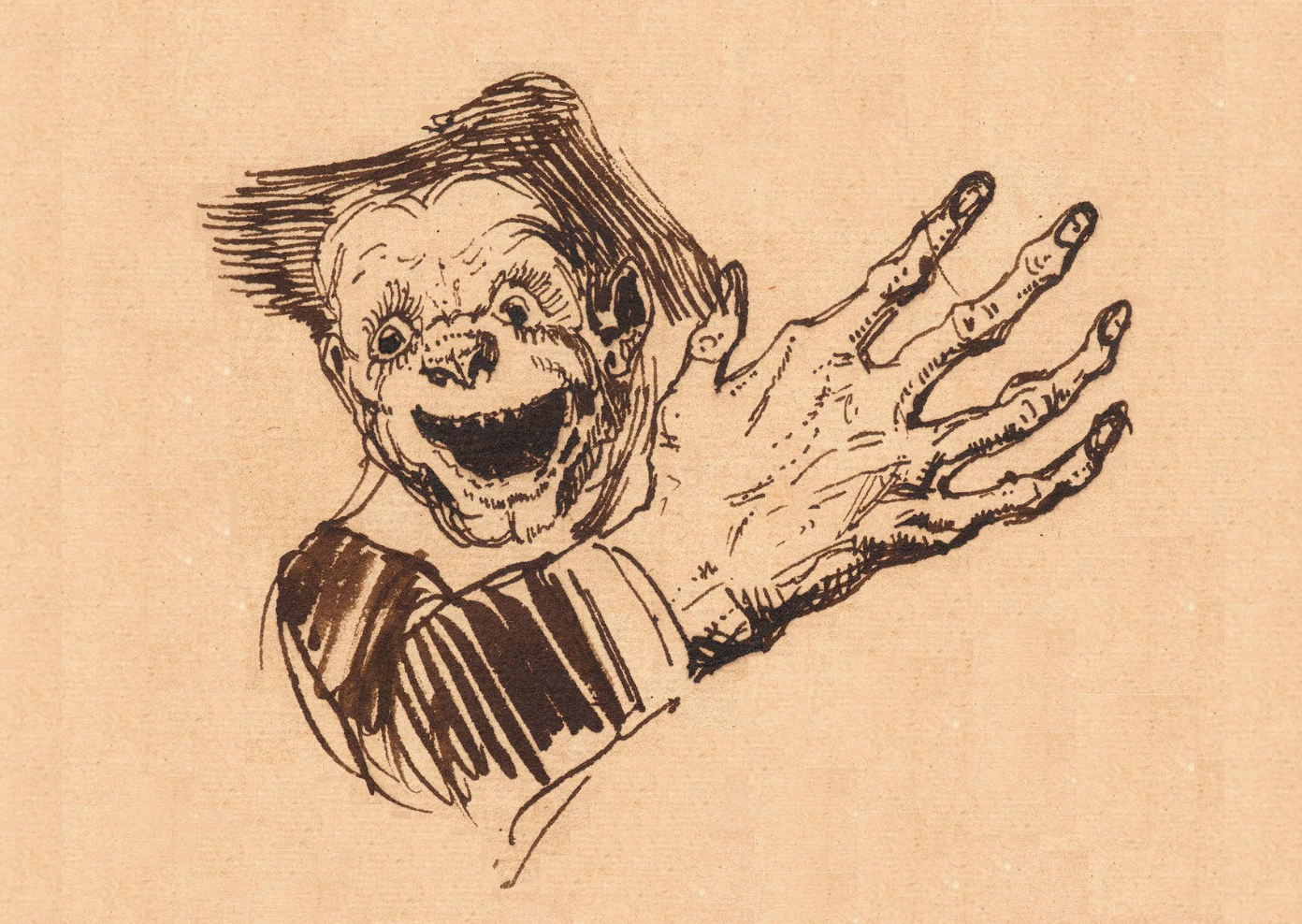
Goya's Caprichos in Nineteenth-Century France: Politics of the Grotesque

ECR French Nineteenth-Century Art Network Research Forum:
Goya's Caprichos in Nineteenth-Century France: Politics of the Grotesque
Dr. Paula Fayos-Pérez - Leonardo Scholarship (BBVA) - Universidad Complutense de Madrid / Université de Strasbourg
Thursday 30 January 2025 1700 (GMT) // 1800 (CET) // 1200 (EST) // 0900 (PST)
The impact of Goya’s work on nineteenth-century French art was immense, long lasting, and multifaceted. Whereas in Spain Goya was associated with his royal portraits, in France he became known as the author of the Caprichos set of prints, which were obsessively studied by artists like Eugène Delacroix—who made over 40 copies. The French Romantics interpreted them as a lampoon of late eighteenth-century Spain, thus overlooking that the true modernity of Goya’s work lies in its universalism, as a mirror reflecting the essence of humankind, unfettered by patriotism—this is also true of his monsters and witches, which are nothing more than the deformed reflection of humans. We could talk about a two-way influence: Goya contributed to shape French Romantic art—and thus the beginning of modern art—and the Romantics in turn modelled his critical image. The established interpretation of Goya is therefore partly based on Romantic stereotypes, many of which have been perpetuated to this day.
Paula Fayos-Pérez is a postdoctoral researcher in Art History (Leonardo scholarship, BBVA Foundation) and is linked to the research groups ARCHE (Université de Strasbourg) and SU+MA (Universidad Complutense de Madrid). Paula obtained her PhD in 2019 from the University of Cambridge. She worked as a researcher at the Wellington Collection (Apsley House), and has published articles in The Burlington Magazine (2019, 2020), Boletín del Museo del Prado (2022), and Print Quarterly (2023). The book Goya’s Caprichos in Nineteenth-Century France. Politics of the Grotesque, based on her dissertation, has just been published by Centro de Estudios Europa Hispánica (2024).
Paula is currently researching the concept of “influence” in Goya and the “Goya network” in nineteenth-century Spain and France.
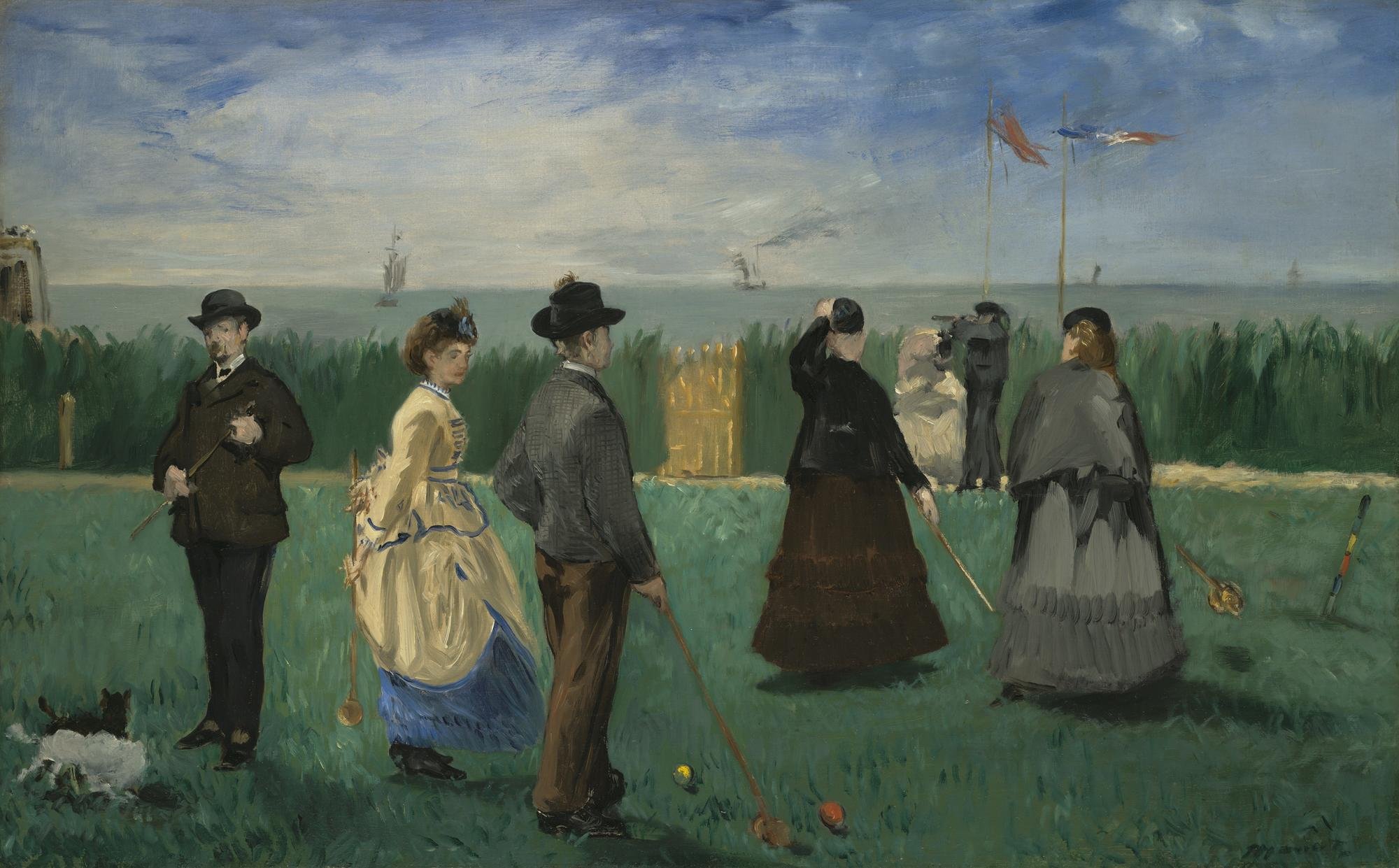
Curatorial Roundtable: Manet: A Model Family

ECR French Nineteenth-Century Art Network presents:
Curatorial Roundtable: Manet: A Model Family
Thursday 21 November 1600 (GMT) // 1700 (CET) // 1100 (EST) // 0800 (PST)
Every artist has their muses. For Édouard Manet (1832–1883), one of those muses was family. But the home life of the French painter was complicated, even by today’s standards. Manet: A Model Family, on view at the Isabella Stewart Gardner Museum, Boston, from 10 October 2024–20 January 2025, explores how despite complexities between relatives, the Manet family lived happily—from a wife who had once been in the household’s employ, to a child of questionable paternity, to a mother who disinherited Édouard’s surviving kin. They were also the artist’s most frequent models, a crucial source of financial and emotional support, as well as creative inspiration. Immortalized in groundbreaking bold brushstrokes, Édouard Manet's loved ones enriched his life and his art. After his death, they cultivated his legacy and ensured that his work would never be forgotten.
Manet: A Model Family at the Gardner Museum is the first exhibition to explore Manet through the lens of the complex familial relationships between and amongst the artist and his sitters, shedding new light on the life and masterpieces of the “father of modernism.”
This network session will offer an opportunity to learn about the landmark exhibition Manet: A Model Family. It will provide a glimpse onto some of the original research that has gone into the exhibition; the curatorial decisions and collaborations that have informed the conception and presentation of the exhibition; as well as the partnerships forged in the securing of unique loans to the exhibition. We will be joined by exhibition curator, Diana Seave Greenwald, William and Lia Poorvu Curator of the Collection at the Isabella Stewart Gardner Museum; Kathryn Kremnitzer, PhD, Vice President, Director, Head of Sale, 19th-Century European Paintings, Sotheby’s New York; and conservator Gianfranco Pocobene, Principal of Gianfranco Pocobene Studio.
Diana Seave Greenwald is an art historian and economic historian. Her work uses both statistical and qualitative analyses to explore the relationship between art and broader social and economic change during the nineteenth and early twentieth centuries, particularly in the United States and France. Diana’s first book, Painting by Numbers: Data-Driven Histories of Nineteenth-Century Art, was published by Princeton University Press in 2021. She is currently the William and Lia Poorvu Curator of the Collection at the Isabella Stewart Gardner Museum in Boston. At the Gardner she has written, co-authored, or edited four exhibition catalogs and books: Betye Saar: Heart of A Wanderer (2023, editor), Fellow Wanderer: Isabella Stewart Gardner’s Travel Albums (2023, co-editor with Casey Riley), Isabella Stewart Gardner: A Life (2022, co-authored with Nathaniel Silver), and Isabella Stewart Gardner: Dog Lover (2020). Prior to joining the Gardner, she was an Andrew W. Mellon Postdoctoral Curatorial Fellow at the National Gallery of Art in Washington, D.C., working in the departments of American and British Paintings and Modern Prints and Drawings. She received a D.Phil. in History from the University of Oxford. She was co-supervised by Professor Kevin O’Rourke and Professor Michael Hatt (University of Warwick). Before doctoral study, Diana earned an M.Phil. in Economic and Social History from Oxford and a Bachelor’s degree in Art History from Columbia University.
Kathryn Kremnitzer joined Sotheby’s in June 2021. She earned her PhD at Columbia University in 2020 with a dissertation that explored how Édouard Manet worked across media in the 1860s. She was previously Research Associate in the Painting and Sculpture of Europe department at the Art Institute of Chicago, where she worked on Manet and Modern Beauty (2019), Monet and Chicago (2020), and Cezanne (2022), and contributed to the online scholarly catalogue of Manet’s works in the collection. As a Curatorial Assistant at The Metropolitan Museum of Art, she worked on Madame Cézanne (2014) and Tiepolo Caricatures from the Robert Lehman Collection (2014). She specializes in 19th-century European painting, particularly French, and works on paper.
Gianfranco Pocobene is Principal of Gianfranco Pocobene Studio, a private practice specializing in the conservation of paintings and murals. He received his Master of Arts in Conservation in 1984 from Queen’s University, and his forty years of experience include fifteen years at the Harvard Art Museums and twenty years at the Isabella Stewart Gardner Museum. At the Gardner he led the conservation department as the John L. and Susan K. Gardner Chief Conservator and also served as its Chief Paintings and Research Conservator where he carried out numerous technical studies and treatments including works by Fra Angelico, Simone Martini, Botticelli, Velázquez, Crivelli, Titian, Degas, Sargent and Manet. While working on Harvard’s University collection, he oversaw the restoration of mural cycles at the Boston Public Library by Puvis de Chavannes, Edwin Austin Abbey and John Singer Sargent and co-edited and co-authored the 2010 publication, John Singer Sargent’s Triumph of Religion Murals at the Boston Public Library: Creation and Restoration.
“Modernism Adrift: Meier-Graefe at the Edge of Impressionism”

ECR French Nineteenth-Century Art Network:
“Modernism Adrift: Meier-Graefe at the Edge of Impressionism”
Dr. Victor Claass (INHA)
Thursday 24 October, 1700 (BST) / 1800 (CEST) / 1200 (EDT) / 0900 (PDT)
With his pioneering writings on modern art, German art critic Julius Meier-Graefe (1867–1935) played a decisive role in the canonization of Impressionism at the turn of the twentieth century. By subversively defending the paintings of Manet, Renoir, and Cézanne across the Rhine, he alienated the conservative elites of the Empire, who remained suspicious of the spread of modernism. Throughout his Franco-German career, which was punctuated by virulent polemics and shaken by the outbreak of the First World War, Meier-Graefe fought against the grip nationalism held on artistic narratives. His project to regenerate German culture was thus inseparable from his efforts to federate a pacified Europe of images. While his Francophile progressivism and the vitalism of his approach to painting have sometimes been emphasized, a study of his involvement in the cultural-political debates of his time reveals a more nuanced personality. This paper will analyze the surprising jolts and paradoxes of Meier-Graefe’s transnational career, which alternated between phases of unbridled enthusiasm and intense disillusionment. Meier-Graefe reveals himself as a thinker of the decline of culture and a champion of an idealized vision of modernism, of which Impressionism incarnated both the quintessence and the swan song.
Victor Claass holds a PhD from the Sorbonne University. His doctoral thesis on German art critic Julius Meier-Graefe was awarded the Orsay Museum Prize in 2018. He was a research assistant at the German Center for Art History in Paris (2012–15), before participating in the international research group Bilderfahrzeuge: Aby Warburg’s Legacy and the Future of Iconology (2015–18). After a postdoctoral year at the Louvre Museum, Victor Claass joined the National Institute of Art History in Paris in 2019, where he works as a research coordinator.
He is the author of Jeux de positions. Sur quelques billards peints (2021), a visual and social history of the game of billiards; directed a special issue of scholarly magazine Perspective about art transportation (2022); and recently co-edited En couple. Historiennes et historiens de l’art au travail (2024), a collection of essays about art historian couples. Based on his doctoral project, his latest monograph, L’impressionnisme à ses frontières Le cas Meier-Graefe et la lutte pour l’art moderne en Allemagne was published in late 2023 by the German Center for Art History.
![Lightning Talks: We [Don’t] Know What You Did Last Summer.](https://images.squarespace-cdn.com/content/v1/629929867d7f1e76a03efc4e/1722154808904-BF34PA22EJ4LSYUY2AWA/11-524593.jpg)
Lightning Talks: We [Don’t] Know What You Did Last Summer.

Lightning Talks: We [Don’t] Know What You Did Last Summer.
Thursday 19 September
1600 (BST) // 1700 (CEST) // 1100 (EDT) // 0800 (PDT)
We are excited to announce the lineup for our September Network Event, “Lightning Talks: We [Don’t] Know What You Did Last Summer.” Composed of brief (8–10-minute) presentations, this session will spotlight the recent and ongoing research of five emerging scholars. They will share their discoveries and reflect on some of the obstacles, successes, and surprises that arise from art historical investigations.
Our speakers are:
Hoyon Mephokee, “Summer Research: Producing Siam in the French Colonial Consciousness”
This summer, Hoyon Mephokee conducted dissertation research on the 1861 visit of Siamese (Thai) ambassadors to France where, at the Château de Fontainebleau, they presented gifts and a letter from the Siamese king Mongkut to Napoléon III and Eugénie. In 1863, under the directive of Eugénie, the gifts were combined with objects looted from China during the Second Opium War to form the so-called Musée Chinois. The Siamese ambassadors were also taken to Paris, where they were photographed by Jacques-Phillippe Potteau, whose portraits were combined by the Muséum d’Histoire naturelle with other ethnographic images to form the Collection Anthropologique du Muséum de Paris. Through the objects and photographs, the Second French Empire was able to materially possess Siam such that it could create its own understanding of the kingdom in service of its imperialist goals in East and Southeast Asia.
Hoyon Mephokee is a PhD candidate at Washington University in St. Louis, where he studies French modern art under Elizabeth Childs. He is primarily interested in decolonial and postcolonial approaches to art history and is specifically interested in interrogating the colonial and cultural threads between France and Southeast Asia. His dissertation, titled “On the Hunt for the White Elephant: Visualizing and Materializing Siam in the French Colonial Imaginary, 1861–1900,” examines the complexity and multi-accentuality of the Siamese Kingdom (present-day Thailand) in the French colonial consciousness.
Dr. Courtney Wilder, “Veuve Cadart: Inheriting the Etching Revival”
Over the summer, Dr. Courtney Wilder catalogued a large collection of etching revival prints as part of her work as a project-based curator at the Vanderbilt University Museum of Art. She noticed several prints credited to “Veuve Cadart,” or Célonie Sophie Cadart (née Chifflart; her brother was the artist François-Nicolas Chifflart), and became curious to assess the role she played in taking over the famous etching revival publishing empire of her husband, Alfred Cadart, when he died unexpectedly in 1875. By 1882, the business had failed, and all assets were auctioned. Despite relatively voluminous scholarship on the Etching Revival, Célonie Sophie Cadart remains a footnote at best; she lacks an ULAN entry and, in the catalogs of several large museums, is listed as her husband or as simply “V. Cadart.” Dr. Wilder will discuss some early questions about what could potentially be learned by looking more closely at Veuve Cadart’s short-lived and ultimately unsuccessful tenure as symbolic head of the Etching Revival.
Dr. Courtney Wilder’s scholarship explores the intermediality of print, with a particular interest in early nineteenth-century textile printing. She is currently the Sullivan Collection Curator at the Vanderbilt University Museum of Art in Nashville, where she is working on a multi-year project to catalog a recently rediscovered trove of over 6,000 prints. She has held fellowships, internships, and research positions at a variety of institutions, including the Metropolitan Museum of Art and the Getty Research Institute; she received her PhD from the University of Michigan in 2021.
Lucile Cordonnier, “When the Corpus Chooses You: Peregrinations of a PhD Candidate”
Spending the entire summer in Paris to conduct research for her dissertation proposal, Lucile Cordonnier’s initial goal was to consult archival sources relating to the four decorative ensembles painted by Maurice Denis and Édouard Vuillard that she had already picked as part of her dissertation corpus. However, after close examination of these works and the primary sources, she realized that her entire dissertation could focus on a single cycle: Maurice Denis’s Légende de saint Hubert, painted for baron Denys Cochin’s hôtel particulier between 1896 and 1897. In this lightning talk, Lucile will outline how she pinpointed the research potential of the Légende and how she shifted her approach to incorporate ecology and eco-criticism, despite incessant doubts and skepticism. Trusting your instincts and diving into new material is, she believes, the foundation stone for conducting exciting and stimulating research.
Lucile Cordonnier is a PhD candidate in Art History at McGill University, working under the supervision of Dr. Mary Hunter. After her undergraduate studies at the École du Louvre and the Université Paris Nanterre, she pursued her Master’s degree at Concordia University. Her doctoral research examines questions of ecology in late nineteenth-century French art, with a particular focus on Maurice Denis. Lucile’s studies at McGill are funded by a FRQSC Doctoral Training Scholarship. Moreover, Lucile benefitted from several grants (French Historical Society, Fonds de Recherche du Québec-Société et Culture, Elspeth McConnell Fine Arts Award, Fred and Betty Price Research Award) to work in museums across France, the United States, and Canada.
Sarah Lawson-Schalles, “The Transatlantic Paradigm: Analysing the Lives of Five African American Artists in Europe During the Long Nineteenth Century”
This research paper focuses on the African American artist Henry Ossawa Tanner, considered one of the most internationally successful African American artists. To further his studies, in 1891 Tanner travelled to Paris, where he found solace in artistic and racial freedom. Moreover, this paper argues that Tanner and other artists in this research project have set a precedent of a transatlantic paradigmatic exchange that would continue into the Harlem Renaissance and years to come. Utilizing archival material as well as secondary sources, this paper will contextualise the period in which Tanner worked during the late nineteenth century in Paris, regarding the social and political climate during the Third Republic in France from 1870–1940.
Sarah Lawson-Schalles is a second-year PhD by-distance student at the University of Edinburgh. Her project is supervised by Professors Michelle Foot and Maryam Ohadi-Hamadani. She completed her undergraduate degree in History of Art at the University of London, School of Oriental and African Studies, which focused on non-western art histories. Remaining at SOAS, she completed her master’s degree in history of art and archaeology, where she developed a great interest in the arts of the African Diaspora. This led to her doctoral research focusing on the transatlantic visual culture of five African American artists who lived and studied in Europe during the long nineteenth century.
Dina Eikeland, “A False Cézanne? Authenticity Debates in Scandinavia in the Mid-War Period”
This June, Dina Eikeland had the chance to stay at the Getty Research Institute as a Library Grantee to conduct research in the archives of The Swedish French Art Gallery in Stockholm. As an important intermediary between the French art world and the Scandinavian art market between its opening in 1918 and throughout the mid-war period, this gallery is a central part of her PhD-research. One of her finds in these archives, concerning the Cézanne painting Avenue (ca. 1880–82), today in the Gotheborg Museum of Art’s collections, is particularly intriguing. After having been declared a false painting by French experts in 1929, it engendered great mobilization within Danish and Swedish art networks to prove the French experts wrong. The authenticity of the Cézanne painting was important for consolidating the collective story telling on the Scandinavian-French relations, in general, and on the Scandinavian acquisition of French late nineteenth-century paintings in particular.
Dina Dignæs Eikeland has been a chargée d’études et de recherche at the Institut national d’histoire de l’art (INHA) in Paris since 2022. Her PhD-research, conducted under the supervision of Professor Dominique Poulot at the Panthéon-Sorbonne University in Paris, explores the renewed interest for French art, especially impressionist and early modern art, in Scandinavia between 1910 and 1938. She aims to document and analyse the Scandinavian reception of French art by focusing on the formation of a transnational network of museum professionals, art dealers, art collectors and art historians engaged in the promotion, acquisition and exhibition of French art in Denmark, Norway, and Sweden.
Queer Reflections: Reconstructing the Long Nineteenth Century's History of Homosexuality in Claude Cahun and Marcel Moore’s Vues et visions

ECR French Nineteenth-Century Art Network: “Queer Reflections: Reconstructing the Long Nineteenth Century's History of Homosexuality in Claude Cahun and Marcel Moore’s Vues et visions”
Weds 26 June 1700 (BST) / 1800 (CEST) / 1200 (EDT) / 0900 (PDT)
In 1919, Claude Cahun and Marcel Moore published their first collaborative project, Vues et visions. This small-run, collector’s edition book, written by Cahun and illustrated by Moore, is made up of 25 pairs of illustrated prose poems that link views of the Breton coastal town of Le Croisic in 1912 with visions of an ancient Greco-Roman past. In this paper, I analyse the relationship the book proposes between past and present, looking at how it receives and reworks nineteenth-century narratives about the history of homosexuality that gave ancient Greece a place of honor. Where other queer authors at the turn of the century use this ancient past to solidify modern gay and lesbian identities, Cahun and Moore, I argue, use the same material to disturb the effects of the nineteenth century’s production of sexual categories, thereby challenging rather than reinforcing the cohesion of identity in their present and our own.
Speaker bio:
Hannah Frydman is an assistant professor of French Studies at the University of Washington where they research and teach on modern French history, literature, and culture, with an emphasis on gender, sexuality, economic life, mass culture, and archival methods. They are currently completing a book entitled Between the Sheets: Classified Advertising, Sexuality, and the Moral Threat to Press Freedom in France (under contract with Cornell University Press). Their work on classified advertising and sexuality has been published in Dix-Neuf, French Historical Studies, Histoire, économie & société, Nineteenth-Century French Studies, and Public Books.

Curatorial Roundtable: Behind the Scenes of Paris 1874

ECR French Nineteenth-Century Art Network presents: “Curatorial Roundtable: Behind the Scenes of Paris 1874”
Tues 7 May 1600 (BST) / 1700 (CEST) / 1100 (EDT)
Join us for a special Network Event to learn about the landmark exhibition Paris 1874: The Impressionist Moment, taking place at the Musée d'Orsay in Paris from 25 March–14 July 2024, and the National Gallery of Art in Washington, D.C. from 8 September 2024–19 January 2025. The exhibition marks the 150th anniversary of the First Impressionist Exhibition by bringing together works from that exhibition as well as from the 1874 Salon, offering a fresh perspective on this critical moment in the history of French art and culture. The speakers will include members of the D.C.-based curatorial team, including Mary Morton, Kimberly A. Jones, and Nikki Georgopulos.
Speaker bios:
Nikki Georgopulos is an art historian, curator, and educator specializing in European art of the nineteenth century. She is an assistant professor in the Department of Art History, Visual Art & Theory at the University of British Columbia. Her current book project traces representations of mirrors and reflection in nineteenth-century French painting. She has also published extensively on the work of Mary Cassatt, looking particularly to Cassatt’s interest and investment in the question of labour, as well as her involvement in the US women’s suffrage movement. She was a part of the Washington-based curatorial team for Paris 1874: The Impressionist Moment while serving as the Andrew W. Mellon Postdoctoral Curatorial Fellow in the Department of French Paintings from 2020–2022.
Kimberly A. Jones received her PhD from the University of Maryland in 1996. A former museum fellow at the Musée national du château de Pau and the Musée d’Orsay, Paris, she joined the curatorial staff of the National Gallery of Art in 1995. Jones has curated a number of exhibitions including Edouard Vuillard (2003–2004); In the Forest of Fontainebleau: Painters and Photographers from Corot to Monet (2008); Degas/Cassatt (2014), Frédéric Bazille and the Birth of Impressionism (2016–2017), and Degas at the Opéra (2020). She is part of the curatorial team for Paris 1874: The Impressionist Moment, which opens in Washington in September.
Mary Morton is curator and head of the Department of French at the National Gallery of Art in Washington, DC. She received her PhD in the history of art and architecture in 1998 from Brown University. Before joining the NGA, she held the position of associate curator of paintings at the J. Paul Getty Museum (2004–2010) and associate curator of European art at the Museum of Fine Arts (MFA), Houston (1998–2004).
Errant Portraiture in the Black Atlantic: Evolutionary Theory and Racial Aesthetics from Haiti

ECR French Nineteenth-Century Art Network:
Errant Portraiture in the Black Atlantic: Evolutionary Theory and Racial Aesthetics from Haiti
Dr. C.C. McKee (Bryn Mawr College)
Thurs 25 April 1700 (BST) / 1800 (CEST) / 1200 (EDT) / 0900 (PDT)
This paper takes as its foundation a suite of seemingly staid realist portraits by the Haitian painter Louis Rigaud exhibited during the 1884 World’s Cotton Centennial in New Orleans. These paintings portray Haitian heads of state from Toussaint Louverture through Lysius Salomon, who was President during the Exposition. While this paper takes an interest in the prominence of Haiti, symbolic and actual, within a burgeoning international black consciousness, I am most interested in the eccentricities of Rigaud’s paintings, which I characterize as a proto-modernist form of Black internationalism. Among these seventeen canvases there are prominent stylistic and anatomical deformities: tropical chiaroscuro backgrounds at the edge of dissolution, architectonically stiff uniforms, clumsily rendered hands, eyes set askew on the face, and physiognomies that verge on caricature. I position this suite of paintings within the discussion of evolutionary aesthetics to interrogate the value of deformity, as an errant articulation of subjecthood, for black peoples in the ongoing struggle for personhood. Rigaud’s paintings form a unique node within the evolutionary theory and racial anthropology that emerged with slavery’s abolition in the Atlantic World. First, they strike a key with a note from Darwin’s manuscript which intimates that “Deformity is required” in the aesthetic evaluation of beauty. Second, Rigaud’s portraits presage the use of evolutionary theory by the Haitian anthropologist Anténor Firmin to affirm the humanity of blackness. For instance, in his 1885 De l’égalité des races humaines, Firmin draws from Darwin to assert that “an esthetic evolution can be accomplished in a race under the empire of the imagination” in order to affirm the beauty of African diasporic individuals. Distinct from both of these positions, Rigaud’s portraits divert the conventions of Western portraiture to represent a modern free black citizenry askew from eugenicist mobilizations of evolution.
C.C. McKee is Assistant Professor of History of Art at Bryn Mawr College and a current Mads Øvlisen Postdoctoral Fellow at the University of Copenhagen. Their research focuses on the intersections of art, colonialism, and natural science in the modern Atlantic World (c. 1750-1950) with an emphasis on the Caribbean. McKee also researches the exploration of colonialism and slavery’s injurious ecological “afterlives” in contemporary Caribbean and African Diasporic art.
This is a virtual event - the Zoom link will be provided upon signup, a reminder will also be sent out in advance of the event. For any issues please get in contact via info@ecrfrenchart.com
This event is open to anyone with an interest in the topic discussed.
About the Research Forum: ECR French Nineteenth-Century Art Network Research Forum is a virtually held research forum that allows recent PhD graduates, early career researchers as well as research fellows to present their most recent research. The forum aims to expose new and emerging scholarship and scholars engaging in exciting areas of research. The sessions will last around one hour, including an opportunity for questions and answers after the presentation. The events are open to all.
About the Network: The network is formed of current PhD students and ECRs working in nineteenth-century visual culture. We have monthly sessions for ECRs to present virtually , allowing them to develop their skills and share their research. It is global, open to those located anywhere in the world who wish to join. Feel free to join and participate, and we hope to create an engaging, diverse, fun and rewarding community.
For further updates and information on forthcoming events please look at our website or sign up to our mailing list . If you wish, drop us an email info@ecrfrenchart.com

Imperial Imaginaries: Visions of a Second French Colonial Empire

ECR French Nineteenth-Century Art Network presents:
Imperial Imaginaries: Visions of a Second French Colonial Empire
in partnership with the French Colonial Historical Society
Thurs 21 March 1600 (GMT) / 1700 (CET) / 1200 (EDT) / 0900 (PDT)
In the second half of the nineteenth century, Napoleon III embarked on a massive program of overseas imperialism. Restoring and expanding the territories previously held by his uncle—notably through conquests in Indochina (modern day Cambodia, Vietnam, and Laos), Africa, and the South Pacific—this “Second French Colonial Empire” became an enduring source of economic power and civic pride for France. Trade with the colonies meant access to valuable raw materials and new markets for French manufactured goods, as well as to “uncivilized” populations patronizingly believed to be in need of assimilation to the French system of values. Indeed, the possibilities for empire were seen as limitless, extending to remote territories not yet explored or claimed by Western powers, including the Arctic.
This session brings together scholars who explore, in different media and geographical contexts, the ways in which a renewed imperial vision of France was constructed, circulated, experienced, and understood, both at home and on a global stage.
Ivana Dizdar (University of Toronto) - “The Domestic North”
In 1855, the French manufacturer Zuber & Cie produced and distributed a wallpaper that featured, among other scenes, an Arctic landscape: complete with a French flag, a sail ship glides through a glacial sea populated by floating ice, glaciers, northern seabirds, and a pair of polar bears at the chilling water’s edge. Despite its portrayal of other regions—Canada, Bengal, Algeria, and Switzerland—the wallpaper’s only portrayal of humans is in the Arctic scene. That the manufacturer and designers, botanical illustrator Eugène Ehrmann and animal painter Théophile Schuler, chose to interpolate human figures in the wallpaper’s Arctic scene is striking. It counters nineteenth-century conceptions of the Arctic as a vast and empty space, devoid of human life, and instead reflects the fact that European powers like France were invested in seeing the Arctic as an accessible and even inhabitable place. Crucially, the figures are not situated in optimal climatic conditions but are thrust into the harshness and precarity of the extreme north. The scene suggests that France has no limit: nothing, not even the risks associated with freezing temperatures, will hinder its colonial spirit. Given France’s colonial presence elsewhere, why, I ask, do French explorers and the nation’s flag appear not in Canada, Bengal, or Algeria but in the Arctic? I argue that Zuber raises the flag in the Arctic precisely because—not in spite—of its status as unclaimed territory. Taking the wallpaper as a point of departure, I examine what it meant to effectively claim the Arctic in French nineteenth-century material culture, decorative art, and interior design.
Ivana Dizdar is a PhD candidate in art history at the University of Toronto and a visiting researcher at the Musee d’Orsay. Her dissertation examines representations of the Arctic in French nineteenth-century visual culture.
Yasmine Najm (Leipzig University) – “(Re)spatializing the Empire: French Official Publications in the Metropole and French Indochina, 1814–1914”
My research focuses on the history of French imperialism, press, spatiality, and nation-state-building processes in the nineteenth century. My dissertation, titled “(Re)spatializing the Empire: French Official Publications in the Metropole and French Indochina, 1814–1914,” aims to uncover how French elites imagined and (re)constructed the French empire in the post-revolutionary period and places a particular focus on the colonization of Indochina. To trace the processes of (re)spatialization that took place after the fall of Napoleon I in 1814/1815, I explore the French Journaux Officiels, a form of official press that has rarely been studied as a primary source for historical analysis and thus remains understudied. In my dissertation, I bring together historical analysis and insights from digital humanities to assess the spatial semanticscontained in the journals to analyze the nature of the spatial discourse used to promote both the (re)construction of the Empire and the French nation-state in the metropole and French Indochina. I argue that Official Journals were used as a tool of (re)spatialization both in their role of physical record of the state’s actions and decisions but also discursively as a medium to semantically test and (re)define the spatial dimensions of the French nation-state with colonial extensions, the spatial format of France in the nineteenth century.
Yasmine Najm is a doctoral candidate at Leipzig University and a fellow of the Franco-German College Doctoral of the Ecole Normal Supérieur (ENS-PSL). Her research focuses on the (re)spatialization of the French empire and the role of the official press in the nineteenth century, with a particular focus on French Indochina. Before joining Leipzig University, she completed a double-degree master's program in Global Studies at Leipzig University and Global Economic History at the London School of Economics and Political Science (LSE).
Eve Rosekind (Washington University in St. Louis)—“Building A Modern Empire: Empress Eugénie at the Inauguration of the Suez Canal, 1869”
In November 1869, Empress Eugénie of France arrived at Port Sa’ïd to celebrate the opening of the Suez Canal. The modern waterway between the West and the East connected the Mediterranean Sea to the Red Sea through the engineering triumph of the Isthmus of Suez. This project, led by French diplomat Ferdinand de Lesseps, strengthened the political and cultural relationship between France and Egypt. French artists accompanying the Empress portrayed her journey through Egypt and the opening ceremonies, visualizing France’s central role in the canal project and in uniting West and East. By examining these illustrations, this talk demonstrates how the imagery of Eugénie illustrated France’s imperial leadership and political prowess on the global stage. Furthermore, the French public could imagine themselves traveling alongside their Empress, marvelling at their technological innovation and their role in guiding Egypt into the modern era. These images of Eugénie affirmed France’s continued imperial investment in Egypt.
Eve Rosekind is a PhD. Candidate in Art History at Washington University in St. Louis studying late-nineteenth century French art with an interest in Orientalism and Second Empire Paris. She is in the process of writing her dissertation titled “France Producing Egypt: The Material Cultures of Orientalism, 1869–1922.” She holds a BA in Art History from Johns Hopkins University with minors in French Cultural Studies and Museums & Society and an MA in Art History from Williams College. Eve was previously the Curatorial Assistant for European Decorative Arts and Sculpture at the Fine Arts Museums of San Francisco.
This is a virtual event held via Zoom, details will be provided upon sign up and a reminder will be sent before the event. For any technical issues, please get in contact via info@ecrfrenchart.com
The ECR Nineteenth-Century French Art Network meets once a month during the academic year virtually via Zoom. It is open to current PhD and research students as well as ECRs who have recently graduated and are making their way in the world of academia/museums/education/arts or heritage. It is global, open to those located anywhere in the world who wish to join. Feel free to join and participate; we hope to create an engaging, diverse, fun and rewarding community.
For further updates/information check out our website or sign up to our mailing list . If you wish drop us an email info@ecrfrenchart.com.
Whose Africa? Transnational Memory of the Second Boer War (1899–1902) and Public Sculpture - Dr. Nicholas Parkinson

ECR French Nineteenth-Century Art Network:
Whose Africa? Transnational Memory of the Second Boer War (1899–1902) and Public Sculpture
Dr. Nicholas Parkinson (Institut National d’Histoire de l’Art)
Thurs 22 February 1700 (GMT) / 1800 (CET) / 1200 (EST) / 0900 (PT)
This talk concerns French sculptural commemoration of a faraway foreign conflict between two colonialist powers in present-day South Africa, the Boer republics (the South African Republic and the Free Orange State) and the United Kingdom. The Second Boer War (1899–1902) sealed British hegemony over South Africa and led the Boer governing politicians into exile. Although rarely discussed today, the Second Boer War played an important role in French foreign politics, in part due to the sizable number of French mercenaries who participated in the war. This paper focuses on Raoul Verlet’s public monument to Colonel Villebois-Mareuil. A veteran of the Franco-Prussian War, Villebois-Mareuil was among the hundreds of French troops who volunteered as mercenaries for the Boer army. Following his death at the Battle of Boshof in 1900, Verlet’s sculpture dedicated to his memory was inaugurated in 1902 in Nantes. I argue that French commemoration of the Second Boer War resulted in a symbiotic relationship between Boer republican government-in-exile, who, despite their history as colonizers, wanted to tie the memory of their war to anti-Imperialism, and France, who wanted to project an image as the defender of liberalism.
Nicholas Parkinson is a Carlsberg Foundation Internationalisation Fellow hosted by the Institut National d’Histoire de l’Art. His research explores the relationship between art and power nineteenth-century international and local politics, especially through sculpture, urban space, and historiography.
This event will take place at 1700 GMT
This is a virtual event - the Zoom link will be provided upon signup, a reminder will also be sent out in advance of the event. For any issues please get in contact via info@ecrfrenchart.com
This event is open to anyone with an interest in the topic discussed.
About the Research Forum: ECR French Nineteenth-Century Art Network Research Forum is a virtually held research forum that allows recent PhD graduates, early career researchers as well as research fellows to present their most recent research. The forum aims to expose new and emerging scholarship and scholars engaging in exciting areas of research. The sessions will last around one hour, including an opportunity for questions and answers after the presentation. The events are open to all.
About the Network: The network is formed of current PhD students and ECRs working in nineteenth-century visual culture. We have monthly sessions for ECRs to present virtually , allowing them to develop their skills and share their research. It is global, open to those located anywhere in the world who wish to join. Feel free to join and participate, and we hope to create an engaging, diverse, fun and rewarding community.
For further updates and information on forthcoming events please look at our website or sign up to our mailing list . If you wish, drop us an email info@ecrfrenchart.com

Tracing the Nineteenth Century: Cataloguing, Contexts, and Presentations
This panel will bring together a range of scholars currently working on cataloguing projects across different contexts, from the auction house to the museum. It will highlight the importance that catalogues have within art history, the changing context of their presentation and the need for transparency and accessibility in their preparation. The event will be followed by a discussion and Q&A.

Masculinity and the Post-Imperial Imago in Paul Delaroche’s Le Duc d’Angoulême à la Prise du Trocadéro (1828)

ECR French Nineteenth-Century Art Network Research Forum:
Masculinity and the Post-Imperial Imago in Paul Delaroche’s Le Duc d’Angoulême à la Prise du Trocadéro (1828)
7 December 2023—1700 (GMT)
This presentation examines the attempt to revive the representation of military strength in post-Imperial France. One of the primary efforts to champion a renewed image of martial might during the Restoration was concentrated in a commission that resulted in Paul Delaroche’s portrait Le Duc d’Angoulême à la Prise du Trocadéro (1828). During the Revolutionary and Napoleonic periods, military service was promoted through patriotic propaganda. France’s defeat at the end of the Napoleonic era created a sense of rupture between the ideal of masculinity and its attainability. The opportunity to reclaim military power arose in 1823 when the French army, led by Duc d’Angoulême, reinstated King Ferdinand VII to the Spanish throne. Although the portrait ostensibly depicts the climactic victory of the campaign, Delaroche’s portrait presents a restrained, monarchical form of martial heroism, differing from the exaggerated Napoleon-era portrayal. This research highlights the evolving conception of masculine valor in the post-Napoleonic era.
Dr. Trenton Olsen is an assistant professor of modern art history in the Department of Art History and Visual Culture at Lindenwood University in St. Charles, Missouri. The research he will present draws from his current book research project which investigates portraiture, fashion, and masculinity in post-Napoleonic France. Dr. Olsen graduated with his PhD in art history from The Ohio State University in 2020. Beyond the scope of his current research project, he is also interested in and has published several articles on digital art history and the integration of AR/VR technology into the art history classroom. Outside of these professional interests, he enjoys exploring new restaurants and dishes with his spouse, and geeking out over all things Harry Potter or Greek mythology with his kiddos.
This event will take place at 1700 GMT
This is a virtual event - the Zoom link will be sent out on the day. For any issues please get in contact via email and we will try and help as best we can.
This event is open to anyone with an interest in the topic discussed.
About the Research Forum: ECR French Nineteenth-Century Art Network Research Forum is a virtually held research forum that allows recent PhD graduates, early career researchers as well as research fellows to present their most recent research. The forum aims to expose new and emerging scholarship and scholars engaging in exciting areas of research. The sessions will last around one hour, including an opportunity for questions and answers after the presentation. The events are open to all.
About the Network: The network is formed of current PhD students and ECRs working in nineteenth-century visual culture. We have monthly sessions for ECRs to present virtually , allowing them to develop their skills and share their research. It is global, open to those located anywhere in the world who wish to join. Feel free to join and participate, and we hope to create an engaging, diverse, fun and rewarding community.
For further updates and information on forthcoming events please look at our website or sign up to our mailing list . If you wish, drop us an email info@ecrfrenchart.com

Transformation and Trouble: Photography as a Tool in Nineteenth-Century France

Transformation and Trouble: Photography as a Tool in Nineteenth-Century France
9 November 2023 - 1600 (GMT) / 1700 (CET) / 1100 (EST) / 0800 (PST)
It is hard to overestimate the extent to which the advent of photography in the early nineteenth century changed the course of visual culture in France and abroad. New photographic inventions, such as Louis Daguerre’s ‘diorama’ (a popular Parisian spectacle featuring theatrical painting and lighting effects) introduced novel visual mechanisms to a wide audience. Though denigrated by critics like Charles Baudelaire for its presumed limitation to merely reproduce the visible world, photography was in fact in dialogue with other means of visual expression. Artists such as Eugène Delacroix and Paul Cezanne were indebted to the medium for the development of many of their paintings; Eadweard Muybridge’s photographic studies of bodies in motion allowed artists such as Edgar Degas to reconsider the artist’s capacity to depict movement. While linked to aesthetic and scientific advancement, however, photography was equally a vital tool for French colonial endeavours, reinforcing propagandistic messages, justifying missionary activities, and lending seemingly objective evidence to the pseudoscientific project of eugenics and related endeavours of white supremacy. The tool of photography was put to many uses, unified by its promise of technological progress.
We are pleased to announce the following speakers:
Isabelle Lynch (University of Pennsylvania) - "'World Without Sun': The Diving Bell, The Camera, and the Rapture of the Deep."
“Is an underwater environment unsuitable for taking good photographs?” pondered marine zoologist and pioneering underwater photographer Louis Boutan (1859–1934), frustrated with what he described as the “shapeless” and “clouded” images taken by his submerged camera while researching mollusks at the Observatoire océanologique (Arago Marine Laboratory) in Banyuls-sur-Mer, France. Artificial light made photography possible in spaces no sunlight reaches, and as early as 1893, Boutan seized artificial fire to conquer the depths of darkness and bring forth pictures of the sea floor.
Described by the oceanographer and filmmaker Jacques Cousteau as a kind of “Prometheus who had given mankind fire and thus artificial light,” Boutan developed underwater flash technologies, specialized camera housings, and remote-control technologies for deep waters using an electromagnet. Collaborating with electrical engineers M. Chaffour and (later) Joseph David, Boutan developed various lighting technologies to illuminate and visualize underwater environments: dangerously explosive underwater flash bulbs where magnesium coils burned inside oxygen-filled glass bottles, and later, battery powered carbon-arc lamps. How might the materiality and agential capacities of artificial light—which explodes and creates dense clouds of vapor—confound ambitions of scientific objectivity and oceanic visuality? Situating Boutan’s experiment with underwater flash photography within the context of burgeoning research in underwater optics, this paper considers the temporality and “liquid intelligence” of artificial light.
Isabelle Lynch is a PhD candidate at the University of Pennsylvania who studies modern and contemporary art. Her dissertation focuses on the role of artificial light in processes of photographic exposure, development, and projection. She currently lives in Chicago where she teaches at the School of the Art Institute of Chicago.
-
Édouard de Saint-Ours (University of St Andrews) - “Capturing the French imperial imagination: Émile Gsell’s photographs at the edge of colonial desires in Indochina, 1865–79”
In Picturing Empire (1997), James Ryan writes that Samuel Bourne’s aesthetic motivations in creating his commercial photographic portfolio of the British Raj between 1863 and 1870 does not absolve his work of imperial ideology because the context of imperialism was itself ‘a major source of imaginative power’ for photographers (p. 55). This was a euphemism, considering the colonial biases conveyed both in Bourne’s writings and photographs. There were many ways in which photographers could and did support the global agendas of imperial powers, whether they were operating at the forefront of colonial expansion or at the very centre of empire, whether their pictures were disseminated as prints in colonial settlements, or as engravings in the mainland’s illustrated journals.
Émile Gsell is a case in point. A commercial photographer operating from Saigon, the capital city of French Cochinchina (present-day Ho Chi Minh City in southern Vietnam) from 1865 until his death in 1879, he appears to have received only one commission from the colonial authorities. Yet his work often embodied the edge of French designs in Southeast Asia, whether geographically thanks to the expeditions he was able to join, or iconographically through the performance of colonial desires in front of the lens (depicting indigenous women as available, presenting local rulers as loyal allies, rendering tribal people as tame and visible). Furthermore, Gsell’s photographs also circulated widely in illustrated journals and books rife with colonial rhetoric and in the colonial sections of international exhibitions. In this talk, which draws on material in my dissertation, I argue that the apparent contradiction between commission and production actually bears witness to a tacit transaction existing between Gsell and the colonial project at large, as well as to the systemic nature of this relation and the efficacy of photography as a tool of imperial vision. I suggest that the imperial imagination was so ingrained in colonial society that an ambitious and savvy photographer could not fail to give it visual currency. In turn, his production, made appealing by a certain talent for the medium, could not fail to sell.
Édouard de Saint-Ours is a historian of photography specializing in the early development of the medium in Asia. Trained in art history and museology at the École du Louvre (2012–2017), he pursued his doctoral studies at the Universities of St Andrews (Art History) and Le Havre (Contemporary History) and is preparing a thesis on the place of photography within the French colonial enterprise in Indochina in the 19th century. His work has been published in the journals History of Photography, Photographica and Le Magasin du XIXe siècle, and more recently in the collective work Mondes photographiques, histoire des débuts (2023), the catalogue of the exhibition "Ouvrir l'album du monde. Photographies (1842-1911)" at the Musée du quai Branly - Jacques Chirac. Édouard de Saint-Ours also works at the Musée national des arts asiatiques - Guimet, where he took over as Curator of Photographic Collections in October 2023.
-
Sophie Lynch (University of Chicago) - "The Blur of Market Labor: Eugène Atget’s Photographs of Les Halles"
This paper considers the blurs that emerge across Eugène Atget’s photographs of market vendors at Les Halles, the busy central market of 19th century Paris. As a visual effect, photographic blur is often an indication of movement that could not be apprehended: residue of that which eluded the speed of the shutter. In these works, the photographer’s lack of control over the unfolding movements of labor offers a series of images that are not easily legible. A spectral figure appears to hover over boxes of fresh produce, lingering on the threshold of photographic visibility. In another photograph, women are hunched over counters, the rapid movements of hands counting coins or garlic cloves blurred by the photographic apparatus. Through the movements of their labor, the figures resist complete photographic legibility. Indistinct expanses invite the deceleration of viewing experiences; half-glimpsed figures emerge and retreat, at times seeming to flee from visibility and evoking the instabilities of experiences of movement and migration. The contours of their bodies only partially expressed, the blurred workers recall the complexities of lived experiences in turn of the century Paris, as well as the spectral past’s imbrication within encounters of daily life. By failing to depict labor through legible forms, the photographs poetically portray the everyday movements of labor and interrogate the ability of a photograph to function as evidence, shining a light on the socio-economic conditions of labor. Through a focus on relations between blurred photographs, movement and labor in Paris at the turn of the century, I argue that blurs caused by the movements of workers come forth as sites of temporal disruption, fugitivity, and resistance.
Sophie Lynch is a PhD candidate pursuing a joint-degree in the departments of Cinema & Media Studies and Art History at the University of Chicago. She studies modern and contemporary art, photography and film from the late 19th century to the present. Following her interests in historical intersections of bodies and technologies, her dissertation considers blurred images in works of photography and film from the late 19th and early 20th centuries.

Bespoke, Ready-Made . . . or Something in Between? Modularity and the Market for Funerary Monuments in 19th-Century Paris

ECR French Nineteenth-Century Art Network Research Forum:
Bespoke, Ready-Made . . . or Something in Between? Modularity and the Market for Funerary Monuments in 19th-Century Paris
19 October 2023—1700 (BST)
Early 19th-century burial reforms in France formulated a heavily regulated system of burial that, most radically, promised all citizens the right to separate burial plots within public cemeteries, regardless of class or religion. This practice not only transformed how people were buried, butalso how the lives of otherwise unremarkable individuals were commemorated and valued. This talk will address the popular market for funerary monuments and the marbriers who produced them. Historically decried as cheap reproductions of monumental funerary architecture, the marbriers’ output was significantly customizable by necessity. Marketed and sold to a highly segmented clientele with diverse budgets and taste preferences, the “modern” style tombs of this period gesture towards a previously unexplored relationship to the architectural éclectisme of the late 19th and early 20th centuries.
Kaylee P. Alexander is the Assistant Research Data Librarian in the J. Willard Marriott Libraryat the University of Utah. She received her PhD in 2021 from Duke University, where she wasalso a research assistant with the Duke Art, Law, and Markets Initiative. Kaylee’s firstmonograph,A Data-Driven Analysis of Cemeteries and Social Reform in Paris, 1804–1924, wasrecently published with Routledge’s Research in Art History series.
This event will take place at 1700 BST
This is a virtual event - the Zoom link will be sent out on the day. For any issues please get in contact via email and we will try and help as best we can.
This event is open to anyone with an interest in the topic discussed.
About the Research Forum: ECR French Nineteenth-Century Art Network Research Forum is a virtually held research forum that allows recent PhD graduates, early career researchers as well as research fellows to present their most recent research. The forum aims to expose new and emerging scholarship and scholars engaging in exciting areas of research. The sessions will last around one hour, including an opportunity for questions and answers after the presentation. The events are open to all.
About the Network: The network is formed of current PhD students and ECRs working in nineteenth-century visual culture. We have monthly sessions for ECRs to present virtually , allowing them to develop their skills and share their research. It is global, open to those located anywhere in the world who wish to join. Feel free to join and participate, and we hope to create an engaging, diverse, fun and rewarding community.
For further updates and information on forthcoming events please look at our website or sign up to our mailing list . If you wish, drop us an email info@ecrfrenchart.com

Building an Exhibition: Degas & the Laundress

Building an Exhibition: Degas & the Laundress
13 September at 1500 (BST) // 1600 (CEST) // 1000 (EDT)
Online // Free
Join us for a special Network Session to learn about the landmark exhibition Degas and the Laundress: Women, Work, and Impressionism taking place at the Cleveland Museum of Art between 8th September 2023 and 14th January 2024. The exhibition brings together dozens of Edgar Degas’s representations of laundresses, a subject that he undertook in a variety of media throughout his career. In addition to works pictorializing the labor of laundresses by Degas and his contemporaries, the exhibition will feature ephemera contextualizing the public image and reputation of this working-class symbol throughout the late nineteenth century.
We will be joined by two members of the exhibition team: Britany Salsbury, Curator of Prints and Drawings at the Cleveland Museum of Art; and Ivey Barker, Andrew W. Mellon Photograph Conservation Fellow at the Cleveland Museum of Art; as well as two catalogue contributors: Aleksandra Bursac, PhD Candidate, University of Toronto; and Jillian Kruse, PhD Candidate, Case Western Reserve University. We will hear about the show’s conception and organization, the collaborative research that made it possible, and the objects within. The event will be followed by a discussion and Q&A.
Our Speakers:
Britany Salsbury is curator of prints and drawings at the Cleveland Museum of Art. Her previous exhibitions and publications include Altered States: Etching in Late 19th-Century Paris (2016) and Nineteenth-Century French Drawings from the Cleveland Museum of Art (2023). Her research has been published in journals including Nineteenth-Century Art Worldwide and Print Quarterly, and with Ruth E. Iskin, she co-edited the book Collecting Prints, Posters, and Ephemera: Perspectives in a Global World (2019). Her doctoral dissertation on print portfolios in fin-de-siècle Paris, completed at the Graduate Center of the City University of New York, was supported by the Getty Research Institute and the Andrew W. Mellon Foundation.
Ivey Barker is the Andrew W. Mellon Photograph Conservation Fellow at the Cleveland Museum of Art. She earned a Master of Arts in Photographic Preservation and Collections Management from the University of Rochester, in collaboration with the George Eastman Museum. Her graduate studies and research culminated in the disaster response thesis and workshop, “Water Emergency Response for Aqueous Inkjet Prints.” In addition to being a Fulbright alumna, she has recently held positions at the National Archives and Records Administration in Washington, DC and the Image Permanence Institute at the Rochester Institute of Technology in Rochester, NY.
Aleksandra Bursac is a PhD candidate at the University of Toronto. Her dissertation explores how Degas used particular motifs to engage with media and materiality, and to negotiate larger social questions. Her essay in the catalogue for the upcoming exhibition Degas and the Laundress at the Cleveland Museum of Art draws on this work. She will be a curatorial intern in the department of paintings at the Getty Museum in 2023–2024.
Jillian Kruse is a PhD candidate in the joint Art History program at Case Western Reserve University and the Cleveland Museum of Art. Her research focuses on nineteenth-century European works on paper with particular interests in ecocriticism, experimental printmaking, and the connections between artmaking, anarchism, and utopia in the prints of Camille Pissarro. She has held positions at the National Gallery of Ireland, the Museum of Fine Arts, Boston, the Hood Museum of Art at Dartmouth College, and the Philadelphia Museum of Art. Jillian currently serves as a curatorial intern in Prints and Drawings at the Cleveland Museum of Art.

The Illustrated Press in France: An Art of the Everyday
Newspapers and illustrated journals have an important place in the visual culture of nineteenth-century France. Many scholars have remarked on the mass newspaper as the quintessential modern and urban form. As Richard Terdiman has noted, the newspaper "became the most characteristic informational and commercial institution of the nineteenth century." Across the century, we find a broad range of artistic engagements with the printed press, from satirical journals and saucy magazines, to specialist women’s publications, illustrated supplements, and publications with deep political polemic. The variety of these publications are embedded within a nexus of commerciality, mass culture, advances in technology, politics, ideology, and promotion. Taking as its starting point the broad theme of the press in nineteenth-century France, this session will bring together scholars working on the illustrated press across these wide and varied publication types.