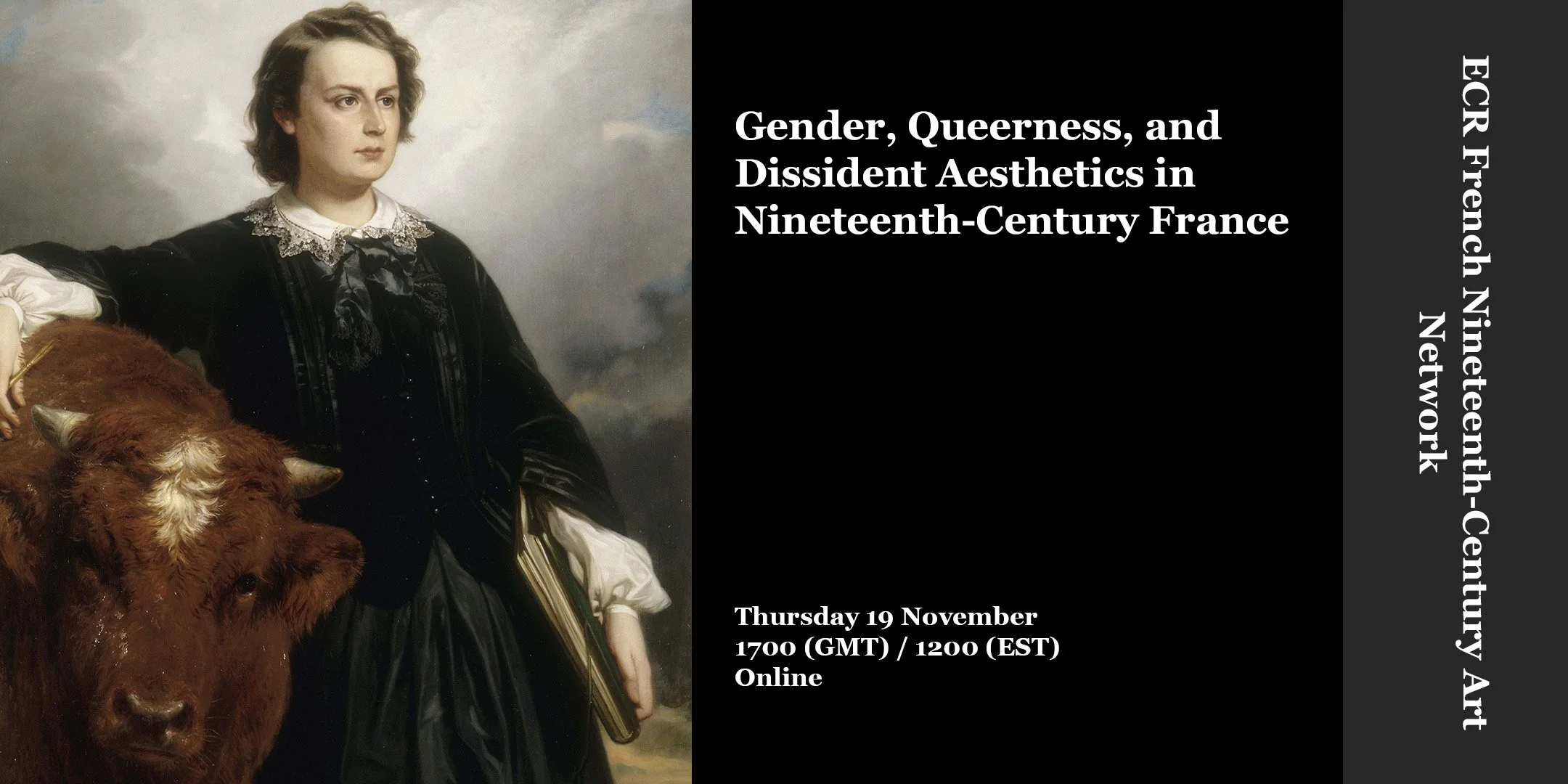
ECR French Nineteenth-Century Art Network Event:
“Gender, Queerness, and Dissident Aesthetics in Nineteenth-Century France”
Thursday 19 November 2026
1800 (CET) // 1700 (GMT) // 1200 (EST) // 0900 (PST)
The nineteenth-century French visual field was shaped by persistent negotiations around gender, sexuality, social belonging, and artistic convention. This session brings together three papers that approach these questions from distinct perspectives, examining how artists, artworks, and artistic communities could challenge, negotiate, or expose the limits of normative categories. From the Saint-Simonian communities of Ménilmontant and By-Thomery to the public construction of Rosa Bonheur’s unconventional celebrity and the homosocial worlds represented in Renoir’s paintings, the presentations explore the ways in which gendered and sexual identities were articulated through aesthetic forms, social relations, and practices of looking. Together, they ask how queer and dissident aesthetics might offer new ways of understanding nineteenth-century French art, its institutions, and its competing models of belonging.
Mal Meisels - “Taking the Habit: Religious Performance and Orientalist Drag in early Saint-Simonian Costuming Practices (1832–1833)”
This talk will analyze the costuming practices of Saint-Simonian disciples in Paris, Lyon, Marseille, Constantinople, Alexandria, Cairo, Beirut, and Jerusalem in 1832 and 1833. Saint-Simonianism, a religious and social movement founded in the early nineteenth century by noble-born French philosopher Henri de Saint-Simon, advocated for principles of universal association, industrial progress, and androgynous theology. In the early 1830s, Prosper Enfantin, a key religious leader after Saint-Simon’s death, encouraged his followers to transform their doctrine into fleshy realities with costumes, architecture, religious performances, and communal living. Meisels argues that Enfantin’s Saint-Simonian doctrine was buttressed by queer aesthetics, and these principles were predicated upon an orientalist imaginary. The resulting artistic production from this queer and orientalist aesthetics became critical for the movement’s proselytizing efforts in France and abroad. Meisels will highlight how Saint-Simonians adopted clothing items and motifs from across time, space, and cultures—a form of drag—to reflect their utopian, yet colonial, pursuits for international audiences.
Mal Meisels (they/them) is a Ph.D. candidate in the UCLA Department of Art History. They specialize in nineteenth-century French art with a focus on queer aesthetics, citizenship, human-nonhuman relations, and Orientalism. They recently published the article, "Queer Aesthetics and Its Others: Human Autonomy and Nonhuman Subjugation in the Passy Cravat (1864)," in Arts about Rosa Bonheur and her collaborators. Mal's dissertation, “Making Spirit Matter: Queer Aesthetics and the Figuration of Doctrine in Experiments with Saint-Simonian Citizenship (1830–1870),” follows Saint-Simonian artists, artisans, performers, and audiences who employed a queer aesthetics to pursue various forms of citizenship (familial, universal, imperial, and industrial) from 1830–1870. Mal’s research is deeply connected to their teaching and curatorial practices. In 2025, they curated Queer Kin: Histories of Subversive Love at the William Andrews Clark Memorial Library, closely attending to moments of LGBTQIA+ mutual care, romantic connection, sexual desire, and family structures within the Clark’s collections.
Dr. Jennifer Thatcher - “Interviewing Rosa Bonheur”
How did it feel to be internationally famous in the second half of the nineteenth century: a source of pride or an unwelcome intrusion? The most successful woman artist in France during her lifetime, Rosa Bonheur was interviewed around a dozen times in French and American periodicals from 1858, when she was 36, to 1899, the year of her death at 77. In this paper, research-in-progress for a monograph on the Transatlantic origins of the artist interview, Dr. Thatcher will investigate the backstory to some of these interviews, including the reputation of interviewer and publication, and the fact that so many interviewers turned up uninvited. Were interviewers interested in Bonheur’s work as a world-renowned animalière; her rags-to-riches background as a self-taught artist from a humble family of artists; or her unconventional lifestyle in her isolated chateau, living with another woman among a menagerie of domestic and exotic animals?
Dr. Jennifer Thatcher is an art historian, critic and public programmes curator. She is the co-editor of Theorising the Artist Interview (Routledge, 2025) and is working on a monograph titled The Golden Age of the Artist Interview for British Academy Publishing. She is currently a British Academy-funded postdoctoral fellow at Manchester Metropolitan University, researching the nineteenth-century history of the artist interview. She was co-curator of the 2023 Folkestone Book Festival; public programmes curator for the Folkestone Triennial (2014, 2017) and the Whitstable Biennale (2016). She publishes regularly as an art critic.
Anna E. Dobbins - “The Company of Men: Queer Potential in Renoir’s Luncheon of the Boating Party”
In her 1986 essay “Renoir’s Men: Constructing the Myth of the Natural,” Linda Nochlin asserts that “Renoir represents men not merely as consumers of pleasure, but as instruments of it as well.” Nochlin’s reading of Renoir’s paintings situates this pleasure solely within the realm of heterosexual desire. My paper seeks to push this assertion further by investigating the homosocial bonds between male figures in the oeuvre of Pierre-Auguste Renoir to assert an alternative reading of desire within his work. In doing so, I argue for a consideration of queer desire within Renoir’s Luncheon of the Boating Party (1881). Using the theoretical insights of Eve Kosofsky Sedgwick’s Between Men: English Literature and Male Homosocial Desire I contend that the perceived heterosexual rivalry between male subjects in Renoir’s paintings (as they compete for the attention of women) might be a palatable disguise for homosexual desire.
Anna E. Dobbins is an advanced doctoral candidate studying modern and contemporary art at the University of Florida. Her research investigates the construction of gender, sexuality, and eroticism in the nineteenth and twentieth centuries. Anna has presented her research at CAA, the Nineteenth-Century Studies Association, Workshopping Future Directions of Impressionism, and the Feminist inter/Modernist Association. Her research has been supported by the Yale LGBT Studies Research Fellowship and the Rothman Doctoral Fellowship in the Humanities. She is currently completing her dissertation project titled: “Women Surrealists and Queer World Building: Ecology, Abjection, and Dissolution.”