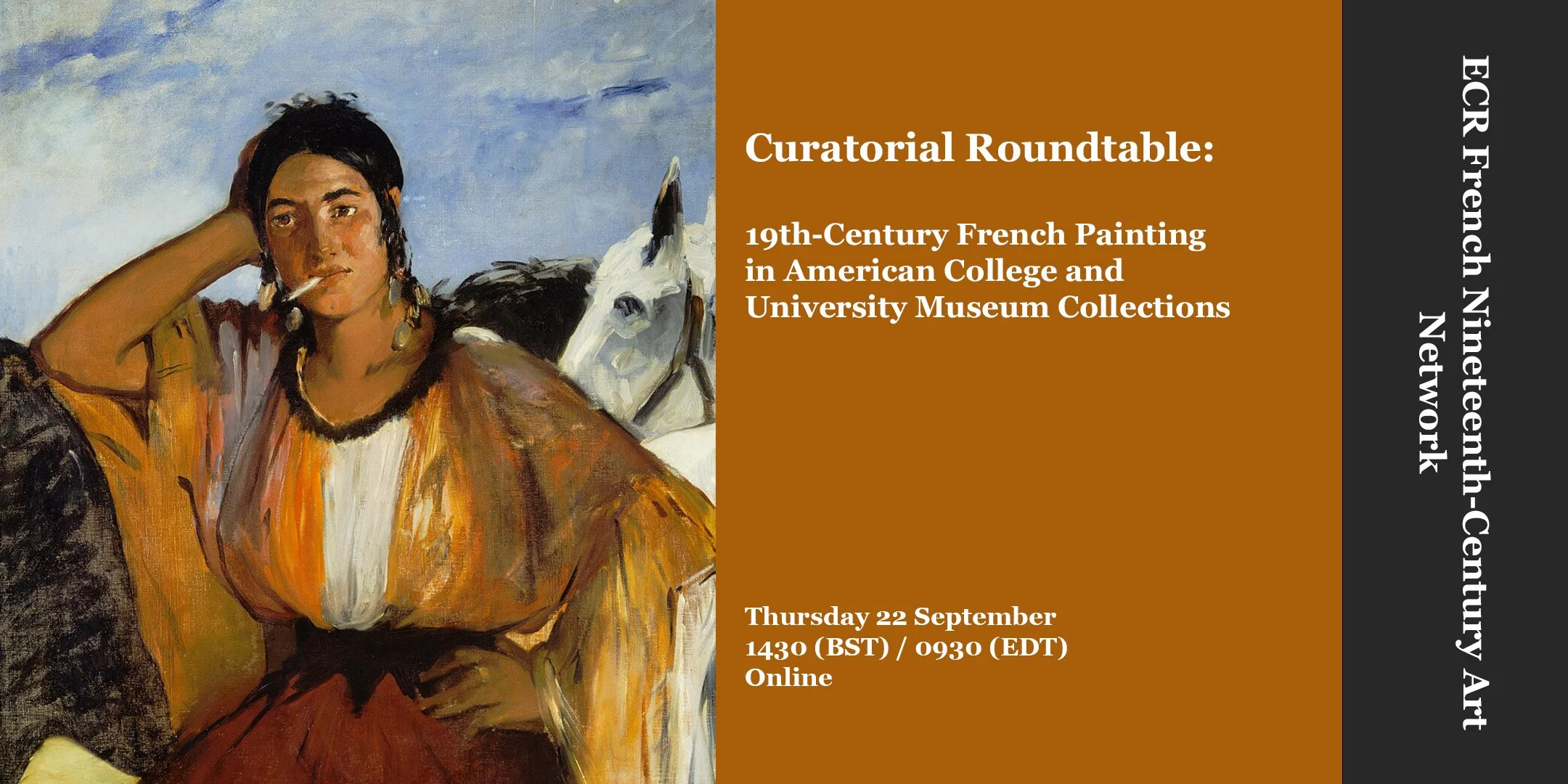
ECR French Nineteenth-Century Art Network presents:
Curatorial Roundtable: 19th-Century French Painting in American College and University Museum Collections
Tuesday 22 September
1530 (CEST) // 1430 (BST) // 0930 (EDT) // 0630 (PDT)
Nineteenth-century French paintings can be found in almost every American college and university museum. How do they fit in permanent collection gallery installations, changing exhibition programs, object-based curricula, and larger campus community life? This panel welcomes three speakers—all affiliated with academic institutions—to discuss at the professorial, curatorial, and directorial level how the longer nineteenth-century plays a role in teaching, collecting, and producing new scholarship within the context of higher education.
Participants:
Sean Kramer
Sean Kramer is Teaching Assistant Professor in Museum Studies and Art History at the University of Pittsburgh, where he teaches courses on the history and ethics of collecting, approaches to collections management, and exhibition development. Before joining the faculty at Pitt, Sean was the Andrew W. Mellon Postdoctoral Curatorial Fellow at the Bowdoin College Museum of Art. In this role, he oversaw curricular engagement with the museum and organized exhibition projects that ranged from nineteenth-century to contemporary art, including subjects such as personhood and dignity and the transatlantic popularity of Harriet Beecher Stowe’s 1852 novel Uncle Tom’s Cabin. He completed his PhD at the University of Michigan in 2022; he holds a BA and an MA from The University of Kansas.
Dr. Kramer will offer a preview of the upcoming reinstallation project Look Again, which opens in November 2026 and will be the first reimagining in almost seventeen years of the Thomas H. and Polly W. Bredt Gallery of European and American Art at the University of Michigan Museum of Art (UMMA). Look Again aims to provide viewers glimpses into significant moments in the museum’s collecting history while asking how art from late nineteenth-century Europe and the United States might still resonate with us. As UMMA, along with numerous other museums, moves away from the encyclopedic model, what does it mean to have a gallery still devoted to a specific time period and geography?
Siddhartha V. Shah
Siddhartha V. Shah joined Amherst College in 2022 as the John Wieland 1958 Director of the Mead Art Museum. He was previously Curator of South Asian Art and Director of Education and Civic Engagement at the Peabody Essex Museum, where he installed the nineteenth- and twentieth-century South Asian Galleries and curated several exhibitions. Shah earned his BA in art history at The Johns Hopkins University, an MA in Jungian psychoanalysis and Hindu philosophy from the California Institute of Integral Studies, and a PhD at Columbia University, where his dissertation examined Imperial styling in Victorian India through fashion, jewelry, and public spectacle. He is currently pursuing an MBA with a focus on Arts Innovation through the Global Leaders Institute.
The Mead Art Museum has had a much more vibrant presence at Amherst College than it has in decades, with significant increase in faculty and student engagement, K–12 group visits, and a 500+% increase in annual donations. Shah attributes much of this success to the innovative ways that the museum is utilizing its historic collections, and he will speak about how the Mead integrates its nineteenth-century holdings into exhibitions that are current, relevant, and broad-reaching.
Alexandra Letvin
Alexandra Letvin is the inaugural Duane Wilder, Class of 1951, Curator of European Art at the Princeton University Art Museum, where she guides the program in European painting and sculpture from the medieval period to 1945. A specialist in the art of early modern Spain, Letvin’s projects at the Museum range widely and include the installation of the European galleries (2025) and an upcoming exhibition on Édouard Manet’s Woman with a Cigarette (2027).
Dr. Letvin will speak about her upcoming exhibition, Manet’s Bohémienne, which highlights the complex ways in which nineteenth-century French ideas of race and identity shaped the making and reception of one of Édouard Manet’s least understood paintings, now in Princeton’s collection. The exhibition disentangles the painting’s title and reception history to resituate the picture within Manet’s work and reconsider its subject, exploring Manet’s artistic practice and use of models, as well as nineteenth-century French perceptions of Spain and the Roma.